Friday, February 24, 2023

Robots and Other Artificial Intelligence Applications – II

This issue, the second of three straight weeks of this series (the jobs report, which drives the monthly AJSN, will be released a week later than usual), is about AI-related articles from January, some of which point up its largest concerns.

 “An A.I. Pioneer on What We Should Really Fear,” by David Marchese in the January 1st New York Times, an interview of prominent front-line researcher Yejin Choi, dealt with the problem of consciousness.  A Google engineer was fired last year for claiming that some of its products could think, but that view actually cannot be refuted, as we do not know from where sentience arises.  Choi said that “when you work so close to A.I., you see a lot of limitations”; we know that such software, and that’s what it is, can be superhuman or even unbeatable in settings where the rules are well defined, such as playing chess or checkers, but in more general situations it may not match a small child’s abilities, as, per Choi, “A.I. struggles with basic common sense,” as “what’s easy for machines can be hard for humans and vice versa.”  Choi in effect considered the decades-old autonomous goal-seeking problem, in which devices do not have constraints people would consider obvious, the main AI issue, a highly reasonable view.

Continuing in another section of the same newspaper was “Consciousness in Robots Was Once Taboo.  Now It’s the Last Word,” by Oliver Whang on January 6th.  The author discussed the views of prominent AI engineer Hod Lipson, who was unsure technology could not be sentient, and said “there is no consensus around what it actually refers to.”  Per Lipson, as far as we can tell, “the fundamental difference among types of consciousness – human consciousness and octopus consciousness and rat consciousness, for example – is how far into the future an entity is able to imagine itself.”  That’s a viable theoretical start, but who can determine what a rat comprehends?  The engineer claimed that, while it may improve, currently “we’re doing the cockroach version.”  This piece has much more, which also clarified that we have a long way to go in understanding what silicon and nonhuman living things think, or in the former case if they do at all.  Hard material, which may defy insight indefinitely.

Swerving to a most practical AI application, we have “White Castle hiring robots to ‘give the right tools’ for serving more ‘hot and tasty food’: VP,” by Kristen Altus in Fox Business on January 7th.  We’ve already seen Flippy, a Miso Robotics device expert at preparing hamburgers and French fries, but not with roll-outs at 100 locations, as has happened here.  Now we can consider restaurant automata a natural response to higher wages, with apparently at least one robust, production-ready product on offer.

A generic term for the internals of chatbots similar to ChatGPT, able to create “text, images, sounds and other media in response to short prompts,” is “generative artificial intelligence,” and was the subject of “A New Area of A.I. Booms, Even Amid the Tech Gloom” (Erin Griffith and Cade Metz, The New York Times, January 7th).  New companies, such as Stability AI, Jasper, and ChatGPT’s OpenAI, have had little recent problem attracting venture capital, with $1.37 billion reaching the sub-sector in 2022 alone.  Although generative AI has been in progress “for years,” only since early last, “when OpenAI unveiled a system called DALL-E that let people generate photo-realistic images simply by describing what they wanted to see,” did it reach the funding forefront.  And there will be much more.

Also in the Times, Cade Metz himself hit the second major implementation issue, in “AI Is Becoming More Conversant, But Will It Get More Honest?” (January 10th).  Problems described here take several different forms.  The first is simple factual errors, as explained by a founder of startup Character.AI, who said “these systems are not designed for truth – they are designed for plausible conversation.”  Second is the effect of extreme and easily refutable views, such as denying the Holocaust, picked up along with valid Internet statements.  A third situation arises when chatbots relay reasonable but still debatable views as facts, and beyond that we have the hardest problem of all – when AI products analyze data and reach conclusions factually defensible but offensive to modern sensibilities.  This article did not get into these.

On January 20th, also by Metz in the New York Times, we saw “How Smart Are the Robots Getting?”  A knotty problem simplified by strict definitions, of which we have possibilities, including passing the 72-year-old Turing Test, “a subjective measure” accomplished when people questioning automata “feel convinced that they are talking to another person.”  Metz ticked off specific AI accomplishments, but the battleground is in less specific settings.  The real current issue “is that when a bot mimics conversation, it can seem smarter than it really is.  When we see a flash of humanlike behavior in a pet or a machine, we tend to assume it behaves like us in other ways, too – even when it does not.”  That is similar to how skilled stage magicians use human shortcomings, such as inability to accurately determine directions of sounds, to bolster and even make their illusions.  There are other intelligence tests described here, and assessing them is not easy.

Next week I continue, maybe with artificial intelligence updates happening after this post’s publication date, and with overall conclusions. 

Friday, February 17, 2023

Robots and Other Artificial Intelligence Applications – I

We’ve been sort of stunned by ChatGPT’s recent exploits, which not only suddenly forced people to adjust their methods but solidly moved AI from the future to the present.  There has been much going on in this field, which should also include robots as they are now truly manifestations of AI.  This post is the first of a three-part series which will break for the March 3rd jobs report and in the unlikely event that something else about jobs and the economy seems more important and urgent.  So now, in chronological order, we start.

First is only a statistic, shared by Emerging Tech Brew citing The Wall Street Journal on September 21st.  In 2021, there were 243,000 industrial robots implemented in China, which was “just about equal to the amount installed by every other country on earth combined.”  Not really shocking, as China has been adding far more industrial capacity than elsewhere, but noteworthy as robots, as sort of anti-human-work, mean that its overall strategy of competing with cheap labor is over.

It's always too soon to make conclusions on such matters, but Farhad Manjoo maintained in the October 7th New York Times that “In the Battle With Robots, Human Workers Are Winning.”  Indeed, when Manjoo asked “weren’t humans supposed to have been replaced by now – or at least severely undermined by the indefatigable go-getter robots who were said to be gunning for our jobs?,” he missed how many people have already been displaced, and that AI and robots are not necessarily comprehensive, and suggested that because widespread, broad-based job elimination has not already happened it never will.  In radiology, a high-skill field now being largely automated, while it is reasonable that “even if computers can get very good at spotting certain kind(s) of diseases, they may lack data to diagnose rare conditions that human experts with experience can easily spot,” there is no reason why a group of such practitioners cannot be reduced, with remaining employees doing more specialized diagnoses for more patients.  Robots will improve and proliferate on timelines of which we cannot be certain.

Not all new automata are highly intelligent, as shown in the imaginative title situation in “Meet Your New Corporate Office Mate: A ‘Brainless’ Robot” (John Yoon and Daisuke Wakabayashi, November 17th, The New York Times).  The authors chronicled a solution for humans being wary of what data such things wandering workplace halls may be collecting, which could be Naver’s devices, “completing mundane tasks like fetching coffee, delivering meals and handing off packages,” skilled at using elevators without interfering with people, and represented as doing only those tasks.  This piece showed well how maximum capability is not be the only robotic goal.

At the other extreme, we have “MIT researchers creating self-replicating robots with built-in intelligence,” by Paul Best in Fox Business on November 27th.  They are “swarms of tiny robots” able to “build structures, vehicles, or even larger versions of themselves.”  This one, though being designed and tested, “will likely be years” before implementation.  Also scary was “San Francisco Considers Allowing Use of Deadly Robots by Police” (Michael Levenson, The New York Times, November 30th).  The idea here was first implemented in the US by Dallas police, who in 2016 “ended a standoff with a gunman suspected of killing five officers by blowing him up with a bomb attached to a robot.”  The real issues here are ethical, not logistical – exactly what situations if any would justify their use – and will need to develop.

We would like to know “How AI is conquering the business world” (Guy Scriven, The Economist, December 10th).  The author saw not giant steps but an accumulation of small tasks, mastered one after another.  When enough of these responsibilities are eliminated, job consolidation can proceed.  That publication issued the unbylined “The new age of AI” in the same edition, saying “artificial intelligence is at last permeating swaths of the business world.”  Examples here included John Deere’s “fully self-driving” farm machines, tools that propose finishing sentences (as in the version of Microsoft Word I am using here), reducing data center energy consumption, rerouting impeded deliveries, sweeping floors, writing first presentation drafts, and generating computer code, all now incorporated into live production settings.  The piece mentioned Nick Bostrom’s observation that “once something becomes useful enough and common enough it’s not labeled AI anymore,” and predicted “an explosion of such “boring AI.””

That may be much of artificial intelligence’s near-term future – but hardly all.  For the first articles of 2023, see the next post in this series. 

Friday, February 10, 2023

ChatGPT – The Artificial Intelligence Event of the Decade

 My previous posts about AI have emphasized actual accomplishments, but mostly these were small-scale, laboratory-bound, or needed more time and iterations to become significant.  What has happened over the last two months needs none of those qualifications.

ChatGPT, per Kelley Huang in “Alarmed by A.I. Chatbots, Universities start Revamping How They Teach” (The New York Times, January 16th), is “a chatbot that delivers information, explains concepts and generates ideas in simple sentences.”  When its use by students to fulfill written assignments reached a Northern Michigan University philosophy class, the professor “read what he said was easily “the best paper in the class,”” on a subject hardly exhausted by current literature, asked the claimed writer if it was really his work, and heard the truth. 

It didn’t take long for word of this capability, not only easily implementable but in use by students, to spread through the academic community.  Per Huang, moving from that professor’s “plans to require students to write first drafts in the classroom” and “using browsers that monitor and restrict computer activity,” others are “phasing out take-home, open-book assignments” in favor of “in-class assignments, handwritten papers, group work and oral exams.”  Some are “crafting questions that they hope will be too clever for chatbots and asking students to write about their own lives and current events.” The management of Turnitin, a “plagiarism detection service,” plans to “incorporate more features for identifying A.I.”

Soon afterwards, related happenings began hitting the press.  Samantha Murphy Kelly told us in CNN Business ten days later when “ChatGPT passes exams from law and business schools,” in these cases doing what was judged as C+-level work at the University of Minnesota law school and getting a “B to B- grade” at a Wharton business management course exam, though making ““surprising mistakes” with basic math.”  Pertinent implications, such as “Long story short:  Will robots take over the workplace?  How to use tech for good” (Alyssa Place, Benefit News, January 27th) about the latest exploits of chatbots in general and ChatGPT in particular, “Potential Google killer could change US workforce as we know it” (Alicia Warren, Fox Business, January 29th), “ChatGPT Just Passed an MBA Exam.  How Will It Change Business?”  (Sarah Lynch, Inc., February 1st), and “Will ChatGPT and AI lead to more layoffs?” (Nate Lanxon, Benefit News, February 6th) soon followed, with necessarily preliminary speculations on how employment could be affected.  “Battle of the labs” (The Economist, February 4th) reminded us that “as the AI race heats up, ChatGPT is not the only game in town.”

What observations can we make about ChatGPT and its ilk?

First, what we have recently seen is not the end but the beginning.  We should expect that some chatbot shortcomings, such as poor arithmetic, will be resolved within the year.  Any advantage of requiring recent news items will most likely go away.  Even, most scarily, it may not be long before a chatbot will be able to access major facts and some details about our lives, and put them into narratives with verisimilitude if not true information.  Therefore, the only way of neutralizing this work-offloading will be to keep Internet access, or even computer access, out of the way.


Second, it is true that this form of AI can be stopped from absorbing entire jobs by duties requiring human-only abilities, but there is no reason why, for example, the responsibilities of two people, each with 50% chatbot-replaceable content, cannot be consolidated into one human-worked position.

Third, once academic-world competition and selection requirements are non-factors, these tools can be immensely valuable.  People from professionals to interested dabblers can use them to generate briefings of sorts on things they want to learn about.

Fourth, we will have both a problem and an opportunity with using chatbot output to determine what could be considered the truth.  We can ask for the equivalent of college papers, or even books, answering questions such as “How can America solve its racial problems?” and “What political views are correct?.”  The disagreements will emerge right away, but the information provided will have more truth than many will be willing to accept.

So let’s allow academia to solve its ChatGPT problem, which dramatically brought AI progress to our attention.  We have bigger fish to fry.  How we do may have a remarkable effect on the quality of our lives in years and decades to come.

Friday, February 3, 2023

Big Jobs Gain in January Offsets Part of Seasonal Unemployment – AJSN Shows Latent Demand at 16.7 Million, Up 1.1 Million


January usually has the steepest drop in American employment.  Millions of people end their holiday-related jobs, and not all find new ones.  The gap between adjusted and unadjusted employment is the year’s largest, as it is for most other work-related labor numbers.

That was at the center of this morning’s Bureau of Labor Statistics Employment Situation Summary.  Dominating the headlines should be the count of net new nonfarm positions, which blew away the also-seasonally-adjusted published 185,000 estimate and turned in 517,000.  Other figures looked good as well – adjusted joblessness trimmed 0.1% to reach 3.4%, average private payroll nonfarm wages beat inflation by jumping 21 cents to $33.03, and the two measures of how common it is for Americans to be working or officially unemployed, the employment-population ratio and the labor force participation rate, each grew a significant 0.1% to 60.2% and 62.4%.  Not improving were the count of those unemployed for 27 weeks or longer, still 1.1 million, and the number of officially jobless, still 5.7 million.  On the down side were unadjusted unemployment, now 3.9% instead of 3.3%, the total working, off 180,000 to 158.692 million, and the number of people working part-time for economic reasons, or holding on to such opportunities while searching for full-time ones, which gained a second-straight 200,000 and is now at 4.1 million. 

The American Job Shortage Number or AJSN, the metric showing how many additional new positions could be quickly filled if all knew they would be easy to get, gained over 1.1 million to reach the following:


More than the total increase was from the officially unemployed and those reporting they wanted work but had not sought it for at least 12 months.  Best showing the overall progress we made was a year-over-year comparison, which revealed that since January 2022 the measure has lost 1.1 million, mostly accounted for by these same two components.  The share of the AJSN from official joblessness rose 3.4% and is now 34.3%. 

On Covid-19, per the New York Times the seven-day daily averages of new cases measured December 16th and January 16th dropped 8% to 59,260, that for deaths measured on the 15ths rose 51% to 564, and that for hospitalizations, on the same dates, grew 7% to 43,137.  Despite the last two worsening, these numbers are well below the virus’s pandemic-era performance and do not indicate particular concern about dangerous jobs.

What do we make of all this?  The AJSN is not seasonally adjusted, so can look worse than it is in down-employment times of the year.  Although we didn’t really add 517,000 jobs, we didn’t lose anywhere near the typical actual December-to-January 700,000, only about one quarter of that.  As any serious poker player can tell you, avoiding losses can be as valuable as winning.  Our population, including children and those well past 65, gained only 113,000 last month, and we are, month after month, adding more jobs than that.  This was another excellent report, and the turtle took another healthy step in the right direction.

Friday, January 20, 2023

Employee Choices II – Quiet Quitting

Another old thing with a still-new name, and perhaps new significance, is “quiet quitting.”  Though as with most new terms not everyone agrees with its precise meaning, it seems to boil down to doing a job’s minimum, without extra effort or extra hours, usually along with a sense of detachment.  As long as there have been jobs, there has been variation in how intensely they are worked, but now, with gaps as large as ever between official requirements and real or imagined expectations, it’s worthy of attention.

One management response gets that in “The quiet quitters are getting quiet fired:  The silent war playing out in offices” (Victoria Wells, Financial Post, October 25th).  The author calls quiet firing “passive-aggressive” and says it “subtly freezes out an employee by either avoiding one-on-one conversations, refusing to provide feedback, neglecting to share critical information needed to do a job, passing them over for a promotion or subjecting them to stingy raises – or no raise at all – while co-workers are awarded more.”  For employees, often in this category because they consider themselves underpaid, “the effect can be demoralizing… which is exactly the point,” as it can provoke them to resign when they are unwanted.  A fair, if not always the most optimal, response.

Two days later, we saw that “Quiet quitting gains steam across every major industry” (Jo Constanz, Benefit News).  In response to a Qualtrics International survey of 9,000 “US full-time or part-time employees,” one of the strongest effects was in “the finance and insurance sector,” which in the previous year “claimed the highest share of engaged employees.”  It is hard to tease out the effects of Covid and the subsequent worker’s market, but something is indeed happening.

Faster-paced employer actions are operating as well, exemplified as “Ford targets quiet quitters with new policy that could see underachievers lose their severance” (Christiaan Hetzsner, Fortune.com, published in Yahoo Finance October 31st).  There, “veteran white-collar workers… face a stark choice if their managers deem them an underperformer,” as some will have a choice of receiving “a buyout now” or risking “failing a performance improvement program,” whereupon they would “lose all claim to a competitive severance package.”  In other words, management wants them up or out.  In contrast to the Wells piece, the workers here have over seven years on the job with unknown problems, as opposed to those usually under 30.

Maybe a carrot would work instead of a stick – or so implied Marguerite Ward on December 12th in Business Insider’s “The solution to low productivity and quiet quitting is simpler than most managers realize:  It’s about making people feel that they matter.”  “A sense of meaning” or something similar has scored remarkably high in studies of what’s important to workers, and Ward gave three suggestions for management to achieve that:  “Dedicate time to checking in (with) your employees,” even by just saying the likes of “good morning” and “how are you?”; “Give positive feedback and be clear on areas for improvement,” the latter long hard for them to execute; and “Create a sense of connection among your team,” including expressing sincere gratitude.  A start, and could help in some cases.

More recently we had two contributions.  In “Managers must ‘solve this problem’ of quiet quitting, Davos leaders say,” in the January 17th MarketWatch, Weston Blasi reported on a panel discussion on “Quiet Quitting and the Meaning of Work” at the latest World Economic Forum meeting.  At this high-profile venue, speakers reached at least partial agreement that “leaders and managers at companies are to blame for the recent surge in quiet quitting “more than anyone else.””

How about another new term, this one related to what we’ve been talking about?  Well, “If You Aren’t Quiet Quitting, You May Have This Viral New Label,” (Veronika Bondarenko, The Street, also January 17th).  “Resenteeism” is “the state of slowly growing more and more frustrated with one’s work arrangement,” or can be having “any unaddressed work-related annoyance.”  It came to the fore with people unhappy they had to report to the office more than they would like.  Resenteeism can but does not always spawn quiet quitting, and, as with the others, does not describe anything new.

What can we do about quiet quitting?  The clearest solutions I can see are synchronizing official and unofficial expectations, praising workers more, zeroing in on the difference between production and hours worked, rediscovering constructive criticism, and implementing greater rewards for better or more voluminous labor.  If everyone gets the same raises, has the same job security, has the same privileges, and knows that work performance doesn’t actually drive promotions, that is a recipe for doing less.  People adapt to their environments.  As for extra hours beyond clearly short-term occasional problems, they show either a human resources problem or workers’ fully voluntary choices.  If companies said what they expected, that would come way down as well.  The choice is theirs – if they want it.

Friday, January 13, 2023

Employee Choices – I

With Covid-19 and the subsequent worker’s market, the set of reasonable worker actions has expanded in many ways.  This is the first of two posts showing how observers have identified and interpreted these possibilities. 

First is Kelsey Koberg’s May 10th Fox Business contention that “America experiencing a ‘great shift,” not a great resignation, argues economic expert.”  The pundit is “Milken Institute senior director Eugene Cornelius,” who maintained that such quitting was usually really a way of looking for better jobs instead of finishing employment, particularly “opportunities for advancement” and higher pay.  It makes sense, as the stronger a job market is, the less workers need to hold on to their positions while seeking others.

A related interpretation came from Brock Dumas, in the same publication on June 8th, when he asked “Why are there still so many Americans quitting their jobs?.”  He cited a career strategist, Julie Bauke, saying that “the changes companies are seeing now are multilayered but largely inevitable” – these differences included younger workers replacing retiring baby boomers, many correctly or otherwise considering themselves underpaid departing, and “a mismatch between people and their skills and what they want to do, with the work that needs to be done.”  Bauke recommended “a novel concept called actually talk to your people and ask them what they want” – she would have done well also to advocate the similarly non-revolutionary idea of paying them more. 

Another look at people leaving the workforce and reappearing was “Many who lost jobs during the pandemic would return for the right pay and position, CNBC survey finds” (Steve Liesman, CNBC, June 8th).  This study showed that an amazing 94% of those who “became unemployed during the Covid pandemic… say they would consider” that, which would help in “returning the labor force participation rate to where it was before the pandemic.”  The most common factors respondents considered regarding coming back to work were flexible hours and salary, with retirement benefits unsurprisingly lowest.

Successful candidates are doing well with another thing becoming more common, as we see “Americans leveraging multiple job offers” (Paul Davidson, USA Today, published in the Times Herald-Record, July 17th).  Those getting more than one acceptance are more able “to negotiate for higher pay and benefits… forcing employers to snap them up quickly or lose out to rivals.”  Companies must more than before heed the rule of making good offers to people they would not like to see working for competitors.  Top reasons for rejecting offers, per a survey Davidson cited, were low salary and an “inconvenient location” (27% apiece), “a job description that didn’t match the actual requirements” (11%), “a desire for remote work” (10%), and “an inflexible schedule” (8%).  Some basic things here, but in such matters they bear emphasis.

Indeed, per Trey Williams in the July 26th Fortune, “Bosses are oblivious to why employees are really quitting.  Here’s what they need to know.”  A high-ranking industry figure who wrote a report on attrition conveyed that workers were most likely to leave because of “not feeling valued by their organization, not feeling valued by their manager, and not feeling a sense of belonging at work,” completely different from employers’ perceptions of “compensation, work-life balance, and burnout.”  The human side is maybe more critical now than ever, and the old truism that people quit bosses instead of companies has strengthened if anything. 

Next week, we jump to October and later, and look at quiet quitting, side hustles, and control over work lives. 

Friday, January 6, 2023

Yet Another Strong Jobs Report – AJSN Reports Latent Demand Down 200,000 to 15.6 Million

Once again, the Bureau of Labor Statistics Employment Situation Summary delivered.

We exceeded the matching 200,000 published predictions of net new nonfarm positions by 23,000.  Seasonally adjusted and unadjusted unemployment each fell 0.2%, to reach 3.5% and 3.3% – both are still range-bound, with the former marking its tenth straight month between 3.5% and 3.7%, but at the bottom.  There were 5.7 million unemployed workers, down 300,000.

Three other results were also favorable.  The count of those jobless for 27 weeks or more shed 100,000 to 1.1 million.  The two measures showing how common it was for Americans to be working or officially unemployed, the labor force participation rate and the employment-population ratio, each rose a substantial 0.2% and are now at 62.3% and 60.1%.  Among numbers tracked here, the only exceptions were the number of those working part-time for economic reasons, or keeping short-hours positions while so far unsuccessfully seeking full-time ones, which gained 200,000 to 3.9 million, and average private nonfarm payroll wages, which increased only the amount of a downward November adjustment and are again reported as $32.82.

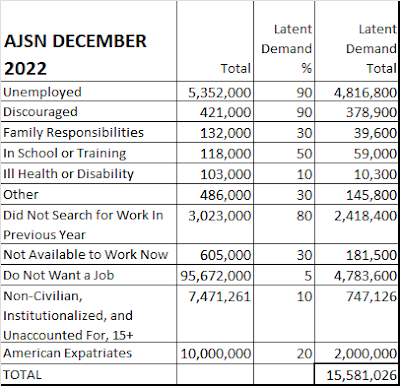
The American Job Shortage Number or AJSN, the statistic showing how many openings in addition to those out there now could be quickly filled if all knew they would be trivially easy to get, lost 220,000 to reach the following:


This metric still improved, despite a Census Bureau national population adjustment which added about 700,000 people which, not coordinated with the BLS numbers above, served to increase the non-civilian et al. count, as those are Americans about whom we have no other employment-status information.  More than offsetting that were, especially, the number unemployed, removing 154,000 from the AJSN, and a smaller count of those wanting to work but not looking for it for a year or more, taking away 131,000.  The share of the AJSN from those officially jobless was 30.9%, down from November’s 31.5%. 

Compared with a year before, the AJSN dropped 759,000, with the numbers shrinking most the officially unemployed, taking 551,000 off the statistic, and those not looking for a year or more improving its contribution by 283,000.

On the Covid front, while the endemic worsened sharply, with, per the New York Times, the 7-day daily average of new cases up 64% to 64,450 from November 16th to December 15th-16th, the same for people hospitalized 45% more at 40,380, and deaths up 12% to 373, these figures are still too low to imply that workers should be avoiding their jobs. 

Overall, where are we now?  Still nowhere near a recession.  Charts published today show that we are adding fewer new positions than for most of the past two-plus years, but they do not include a horizontal line showing how many we needed to cover population increases, which would run through and near the bottom of the monthly histogram bars.  We’re pushing the bottom of the unemployment-share range, hardly a bad place to be camping out.  Wage increases have sputtered, but inflation is dropping.  And none of this has been reversed during the months of higher interest rates.  The good times are rolling, and the turtle once again took a solid step ahead.