Friday, April 21, 2023

Six Months of Home vs. Office – II

Back to the views…

Although we don’t know how strong and long-lasting the current trend toward remote work will be, it must be factored into corporate real estate matters, and so we have “The great refurb: Office design joins the conversation on revamping work” (Julia Hobsbawm, Benefit News, February 8th).  The “seismic changes” which “have been triggered in worldwide corporate real estate” can be divided into three areas:  safety, reflecting that “offices remain targets for attack”; sustainability, the environmental kind; and social space, building “fresh, immersive offices which put social experience” in front, trying to hold off “the ennui driving quiet quitting, career cushioning and all the other white collar rebellions and rejections of post-pandemic working life.”  And yet another new expression appeared here, “pointless presenteeism,” or workers being “in an office for no reason doing work they can do elsewhere.”  If the material here takes hold, offices in another decade may be hard to recognize.

I had Fortune pegged as a conventional, management-favoring organ, so didn’t expect it would be the source of “The return to the office could be the real reason for the slump in productivity.  Here’s the data to prove it” (Gleb Tsipursky, February 16th).  A chart starting about 2010 with output, hours worked, and output per hour showed something of a correlation between higher productivity and high-remote-work times.  The piece also cited studies by Gallup showing “as many as half of all Americans may be quiet quitters” and that “the optimal engagement boost occurs when employees spend 60% to 80% of their time… working off-site,” by the Integrated Benefits Institute connecting high employee engagement and satisfaction to working from remote locations, by Monster finding that “two-thirds of survey respondents would quit rather than return to the office full time” causing a time and effort drain if they then seek new positions, and one by Slack uncovering a surprising tendency of onsite workers to be on video calls, a “terrible use of the office” which is “the kind of thing that leads directly to quiet quitting.”  Well documented and described material, but are there also findings supporting the opposite?

Then, we had “Office Mandates.  Pickleball.  Beer.  What Will Make Hybrid Work Stick?” (Emma Goldberg, The New York Times, March 2nd).  The title is a misnomer – perks and features like these are designed to get people happier only about reporting in person – showing that many companies have given up on anything like five-day office requirements.  All of this is reminiscent of efforts throughout the past thirty years, and I see little evidence here or elsewhere of companies having learned from that.

I’ve warned that remote work is setting ergonomics back several decades.  What else was in Jordan Metzl’s March 14th New York Times “Working From Home Is Less Healthy Than You Think”?  Mainly two things – far less walking and moving around especially with the lack of commuting, going to lunch, and even “taking the stairs at work,” and less exposure to other physical humans.  Metzl, a doctor specializing in sports medicine, pointed out that “our bodies remain the same” and that we have innate needs less compatible with staying at home.  All of that can be compensated for, but that negates at least part of the time savings such employees enjoy.

More openness about working-hours recreation, especially involving an old corporate standby activity, seems to have fueled “Golf at 3pm Thursday?  Sure, It’s the Afternoon Fun Economy,” in the New York Times on March 16th again by Emma Goldberg.  The article mentioned people who “can now extend their leisure time into the afternoon, and tack on extra hours of work after dark.”  Golf course employees reported that their sites were “jammed with a new group of golfers” on weekday afternoons, and many hair salon workers reported the same.  We, though, have no idea what share of employees are consistently making up that time at night or at all.

Another classic problem with laboring from home is at the center of “You Call This ‘Flexible Work’?”, by Fred Turner on April 12th, also in the Times.  He described how homes and workplaces became opposites over 100 years ago, with one for earning money and the other for family and other life activities, and borders that would rarely if ever be crossed.  Those changes took a century to develop and phase in, from out-of-control early Industrial Revolution working hours for children as well as adults to widespread acceptance of the 40-hour week.  Now the line dividing them has been erased, and “what’s becoming clear is that we need a new compact for a new technological era.”  What it will or even should be is most likely too early to say.

I was going to present and discuss remote-work-related elephants in the room this week, but there are simply too many pachyderms – by latest count, eight.  So they will be the subject of my next post.  Be ready to open your eyes!

Friday, April 14, 2023

Six Months of Home vs. Office – I

I was surprised to see how long it has been since I had a post about developments in working in offices, working from home or otherwise remotely, and the combination now referred to as “hybrid working.”  Where have these gone in the past six months?

First was “Forget Free Coffee.  What Matters Is if Workers Feel Returning Is Worth It,” by Hanna Ingber, on October 29th in the New York Times.  This piece mentioned that employees newly required to report some days in person, which “after so long away was always going to be a jarring transition,” often complained that “their lives had changed during the pandemic, and they have had to unravel their at-home lifestyle,” including how to “sort out child care and find time to keep exercising,” with problems “no matter what free snacks a company provided.”  As well, “multiple people said the dog was not happy.”  Many then were leaving, or at least threatening that, for more remote pastures.  The question hanging in the air is “how many hours is this scheduling freedom costing employers?” 

A way in which management has been dealing with people out of sight led to “Remote employee monitoring tech is surging” (Hayden Field, Emerging Tech Brew, November 23rd).  From “pre-pandemic” to “the end of 2021” the share of firms using “tech to measure employee productivity” doubled to 60%, with “eight of the 10 largest private US employers” included by August 2022.  Some of that is from not only more people working from home but the pandemic-caused necessity that all, including those they might not trust, do their jobs from outside the office.  There is much here about measuring productivity, which is easy for data entry, but how can they do that for most cubicle jobs, where neither keystrokes nor hours spent measure effectiveness?  I would be more sympathetic to workers’ indignation if those complaining the loudest were not often those who needed monitoring the most.

On we go to “The open questions of hybrid working” (The Economist, December 1st).  The column told us that “the office is not dead but many professionals have settled into a hybrid arrangement of some office days and some remote days.”  One study found that workers appearing in person between 23% and 40% of the time “performed best on various performance measures,” and another pointed toward younger employees needing to be there more.  The other issue here was “how strictly to enforce attendance on days when teams are meant to be in the office,” if the same days were expected for all.

Then, we have “A new challenge for hybrid and remote workers:  Promotions” (Lee Hafner, Benefit News, January 19th).  Not recent, as “if 80% of success is showing up, how can employees in a home office prove themselves equal to their in-office peers?”  One answer, as I have written before, is to accept that as a disadvantage of appearing less in the office – that is unsatisfying yet may be more realistic than expecting companies “to tap into the individual productivity of their workers and make sure that all are on the same page when it comes to responsibilities and company expectations.”  It is still necessary for ambitious employees to “look for opportunities to engage” and otherwise keep high profiles, and such political realities, critically important since before remote work, cannot be expected to disappear.

Back to nebulous total-time expectations with “5 things employers should know about caregiving and remote work” (Deanna Cuadra, Benefit News, January 19th).  These are “remote work is leveling the gender playing field” assuming acceptability of frequently going back and forth between personal and employment responsibilities, “managers and caregivers are on the same page” likewise, “there doesn’t have to be a downside to remote work” which is highly debatable, “caregivers are working more at home – but they don’t mind” but unclear how or even if they are deducting business-hours child care, and “remote work is here to stay” which if no employee percentages are included is not open to question.  This piece reminded us that the subject of working from home has many questions neither side wants to ask or answer.

Finally this week, representing the other side was “Bad news, remote workers:  You need to return to the office for your employer to succeed” (Bob Shultz, USA Today, February 2nd).  This president and CFO of Puritan Medical Products held that “workplace culture binds a company together,” and “it is almost impossible to build a strong, cohesive workplace culture if most workers are not actually on-site.”  Per Shultz, hybrid setups “are more likely to succeed, given the face-to-face component, but fully remote situations are not nearly as conducive to corporate collaboration,” backed by 2022 research showing “that remote workers do not tend to replace in-person interactions with virtual ones; rather they’re more likely to just drop those interactions together,” and by “a study of 60,000 Microsoft employees (which) found that remote work caused them to “become more static and siloed, with fewer bridges between disparate parts.”  He mentioned Bob Iger, Disney CEO, “urging” people to report in person a minimum of four weekly days and saying that “in a creative business like ours, nothing can replace the ability to connect, observe and create with peers that comes from being physically together, nor the opportunity to grow professionally by learning from leaders and mentors.” 

Overall, do we have a split between employees and employers, or is there more than that?  What looks like the truth?  What other elephants are in this room?  What has happened in the 2 ½ months since?  See next week’s post for all this and more.

Friday, April 7, 2023

Deceptively Strong Jobs Report Shows Great Robustness Behind Headline Numbers, with Latent Demand, Per AJSN, Down 600,000

I can imagine the comments about this morning’s Bureau of Labor Statistics Employment Situation Summary.  Only 236,000 new jobs – indifferent.  Employment down 0.1% to 3.5% - per the BLS, “little changed.”  Nothing much happening – is the market slowing down?  All would be badly misleading. 

Yes, net new nonfarm payroll positions gained less than last month, and were a tiny bit below the published 240,000 estimate.  True, some other measures, including the count of long-term unemployed at 1.1 million, and those working part-time for economic reasons or keeping such work while looking for full-time propositions, still 4.1 million, went nowhere, and average private nonfarm payroll wages, up only 9 cents per hour to $33.18, did not keep up with even recently reduced inflation.  But others, including some likely to get little attention, exceeded that.

Of those, total employment, at 160,741,000, made another million-worker jump.  Seasonally unadjusted joblessness dropped 0.3%, a huge amount with limited seasonal significance, to 3.6%.  The count of unemployed, at 5.8 million, was off 100,000, and the adjusted unemployment rate above reflects an 0.1% drop, more meaningful than usual with the number of people saying they had no interest in work down another 100,000 on top of the million last time.  The two figures showing how common it is for Americans to be working or one step away, the employment-population ratio and the labor force participation rate, both gained, with the latter up 0.1% to 62.6% and the former jumping 0.3% - a lot for this statistic – to 60.4%. 

The American Job Shortage Number or AJSN, the metric showing how many more positions could be quickly filled if all knew they would be easy to get, shaved over 600,000 to reach the following:


The AJSN components above show how stout our employment situation is, and how much better it is still getting.  Of the seven marginal attachment statuses shown in rows 2 through 8, only two – in school or training, and not available to work now – increased this time.  That means, as with fewer claiming no work interest, that Americans are choosing to reenter the job market – and with overall employment numbers rising to historic levels, we see that they are being successful. 

Compared with a year ago, the AJSN also shows we are still improving.  It was over 700,000 higher in March 2022, almost all of the difference from the marginal-attachment categories, especially that of people wanting work but not looking for it for the past 12 months. 

With Covid-19 not a factor and looking like it may never be again, what else can we say about this morning’s data?  It is tremendously solid.  The reality of a strong job market is not in doubtfully significant results such as the drop of advertised positions a few hundred thousand to 9.9 million, of which many, maybe most, are sitting unfilled for good reasons.  It is not in how inflationary the high jobs availability may or may not be – while prices are still increasing, every month’s reports seem to have new 12-month lows.  It is not in taking for granted new-positions figures consistently many times more than our modest population increases can absorb.  And it is not connected with the recession-soon predictions still getting press although moving further and further from reasonability.  These are banner times for work opportunities.  The turtle, once more, took a large step forward. 

Saturday, April 1, 2023

Robots and Other Artificial Intelligence Applications – V

Here is the final installment in this series – at least for now. 

I start with three pieces from earlier this month giving the state of ChatGPT and chatbots in particular, which will continue to evolve but has reached a point where we can talk usefully about where it is going.  The first, “The Chatbots Are Here, and the Internet Industry Is in a Tizzy” (Tripp Mickle et al., The New York Times, March 8th), said that “not since the iPhone has the belief that a new technology could change the industry run so deep,” with the authors forecasting massive shifts for cloud computing, e-commerce, social media, and publishing, affecting “$100 million in cloud spending, $500 billion in digital advertising and $5.4 trillion in e-commerce sales,” although “the volatility of chatbots has made it impossible to predict their impact.”  That spells out the situation now, and only the next several months and beyond will tell the story.

As for the current – or at least three weeks’ ago – technical situation, Cade Metz and Keith Collins told us in the March 14 New York Times that there are “10 Ways GPT-4 Is Impressive but Still Flawed.”  Although “it still makes things up,” its improvements are that “it has learned to be more precise,” “it has improved its accuracy,” “it can describe images with impressive detail,” “it has added serious expertise,” “it can give editors a run for their money,” “it is developing a sense of humor.  Sort of,” “it can reason – up to a point,” “it can ace standardized tests,” but “it is not good at discussing the future” and “it is still hallucinating.”  Expect the next release to be better, sometimes massively, at all of these.  And, if there was ever any doubt, we are getting “Microsoft to bring OpenAI’s chatbot technology to the office” (Dina Bass and Emily Chang, Benefit News, March 16th) – in Office, where I have seen it proposing more continuation text, in LinkedIn, and elsewhere. 

Two more contributions told us things just behind the scenes of artificial intelligence and chatbot’s stunning recent progress.  “The great AI beef,” from Bloomberg Daily on March 8th, told us that “in Silicon Valley, there’s a small but powerful group of people who believe (such advancement) could be very, very bad news – and that AI, if not handled correctly, could wipe out humanity within a couple decades.”  However, “there’s also a crowd who thinks our AI future will be amazing – bringing about untold future capabilities, abundance and utopia.”  “AI theorist” Eliezer Yudkowsky and OpenAI CEO Sam Altman, exchanging detailed comments from their stances on the former and latter sides respectively, have had “a somewhat inscrutable, inside-baseball catfight.”  David Wallace-Wells, in “Silicon Valley’s futurists have gone from utopian to dystopian” (The New York Times, March 27th), recapped the situation between Altman and Yudkowsky and saw the latter scenario winning out among AI developers.  That will mean distortion, ultimately for better or worse, in how the technology progresses.

And how about the philosophers?  Because if you purport to perceive how much AI products are doing the equivalent of thinking, that’s what you are.  In “Can a Machine Know That We Know What It Knows?,” also in the March 27th New York Times, Oliver Whang assumed that role and concluded, after looking at possibly pertinent academic studies, that one academic had concluded that “machines have theory of mind.”  Others responded with further work putting that deduction in doubt. Moving from empirical tests to resolving such issues, which call back to the millennia-old problem of consciousness, might be impossible.

I end with “Noam Chomsky:  The False Promise of ChatGPT,” with two co-authors in the New York Times on March 8th.  The long-time linguistics professor named two large concerns about chatbot output.  First, despite being able to integrate masses of information, “such programs are stuck in a prehuman or nonhuman phase of cognitive evolution,” with an “absence of the most critical capacity of any intelligence:  to say not only what is the case, what was the case and what will be the case… but also what is not the case and what could and could not be the case.”  Second was chatbots not being “capable of moral thinking” by “constraining the otherwise limitless creativity… with a set of ethical principles that determines what ought and ought not to be,” the lack of these guidelines making it susceptible to incorporating clearly incorrect input data.  Ultimately, “they either overgenerate (producing both truths and falsehoods, endorsing ethical and unethical decisions alike) or undergenerate (exhibiting noncommitment to any decisions and indifference to consequences).” 

Chomsky’s assessment is superb – with one caveat.  If AI devices produce views that offend us, we should be able to objectively assess them.  We are still in charge, but we must be open-minded.  That will be a real 21st-century intellectual challenge, and will draw as much controversy as ever.  But we will be better as both leaders and followers when we pursue it.  There is no suppressing artificial intelligence, but as has been true with so many past advancements, it will make an increasingly fine servant but will always – always – be a poor master.

Friday, March 17, 2023

Robots and Other Artificial Intelligence Applications – IV

There is still no topic related to jobs and the economy hotter than this one – bank failures expectedly bailed out do not qualify – and there is no shortage of articles to review, so I continue.

Peter Coy said in a February 22nd New York Times newsletter that “We’re Unprepared for the A.I. Gold Rush.”  Is he right?  He wrote that “it’s coming at us too fast,” that he doesn’t “feel comfortable with Silicon Valley bros telling us to mind our own business while they do their A.I. thing” since “it’s OK to move fast and break things, but it’s not OK to move fast and possibly break the world,” and that government regulators could be heading for a collision with artificial intelligence companies as “the race to cash in on artificial intelligence will lead profit-minded practitioners to drop their scruples like excess baggage.”  The real issue here is that nobody, especially in government, knows as much as the front-line technicians (who themselves understand only small portions of the gigantic AI algorithms), and any limiting measures they take will be as clumsy as using a meat cleaver for microsurgery.  Look out – we will see much more on this issue before it is reasonably resolved.

Per Ezra Klein, on February 26th and also in the New York Times, “The Imminent Danger of A.I. Is One We’re Not Talking About.”  His concern is that we don’t know “who… these machines (will) serve,” which could well end up being advertisers, resulting in artificial intelligence systems influencing users, about whom they have “access to reams of… personal data” and are “coolly trying to manipulate… on behalf of whichever advertiser has paid the parent company the most money.”  The depth and intensity of AI-driven efforts could be mind-boggling and almost impossible to resist.  And as per science fiction writer Ted Chiang, “most fears about capitalism are best understood as fears about our inability to regulate capitalism” – the shortcomings described in the previous paragraph make the issue here another worthy of real concern.

Established technical correspondent Cade Metz asked about and explained another problem, on the same date and in the same publication, in “Why Do A.I. Chatbots Tell Lies and Act Weird?  Look in the Mirror.”  He described systems’ misinformation as being not only garbage in – garbage out absorption of incorrect data, but their programmed ability to incorporate what those questioning them send.  “The longer the conversation becomes, the more influence a user unwittingly has on what the chatbot is saying.  If you want it to get angry, it gets angry… if you coax it to get creepy, it gets creepy.”  And “Microsoft and OpenAI have decided that the only way they can find out what the chatbots will do in the real world is by letting them loose – and reeling them in then they stray.  They believe their big, public experiment is worth the risk.”  So we are forced to take nearly everything this technology provides with a boulder of salt.

On usage, Paula Peralta said and asked in Benefit News on February 27th that “59% of job seekers who used ChatGPT to write cover letters were hired.  Should recruiters be alarmed?”  She didn’t provide overall data on hiring chances, or anything to compare with her statement that “78% secured an interview when using application materials written by the AI.”  These figures may or may not be far higher than for others, but in any event, with professional help long common for applicants’ resumes and other hiring-process inputs, there is no misrepresentation in using chatbots and therefore no cause for concern.

Back to an issue here was “As A.I Booms, Lawmakers Struggle to Understand the Technology” (Cecilia Kang and Adam Satariano, The New York Times, March 3rd).  Since “the only member of Congress with a master’s degree in artificial intelligence” said “that most lawmakers do not even know what A.I. is,” the barriers to effective legislation, to the extent that is possible, are extreme.  As the AI Now Institute’s executive director put it, “” the picture in Congress is bleak.”” And so may be our prospects for even somewhat appropriate regulation.

Well, could it be that after all this, “Reports of humanity’s obsolescence may be greatly exaggerated” (Peter Coy, The New York Times, March 1st)?  Coy reappeared to tell us that AI hasn’t yet gutted technical job demand (though its breakthroughs have been so recent that such could well be on the way).  He interviewed four highly-placed technical managers, finding that experience with a wide range of unusual tools, “understanding human needs,” and data analytics were most valuable, and judged that the field would continue to do well, since “jobs are ripe for automation when they are standardized and unchanging,” and “jobs in the tech sector are anything but that.”  So positions there will still be around for a while, though as it is still hardly assured that employers will provide American salaries and benefits for them.  But that’s another concern. 

I will not be posting next week, but expect more on this subject on the last day of March.

Friday, March 10, 2023

February Jobs Report: More Positions, Fewer People on Sidelines, AJSN Down to 16.7 Million Latent Demand

This morning’s Bureau of Labor Statistics Employment Situation Summary was supposed to be a critical one, for the wrong reasons.  Observers were hoping for decreasing employment and fewer new jobs, as if those things alone would reduce inflation.  They didn’t get that.

Heading the data was 311,000 net new nonfarm payroll positions, way past the published 200,000 and 215,000 estimates.  Soon after that was seasonally adjusted unemployment increasing from 3.4% to 3.6% - but wait a minute!  The cause of that can be seen in other results, especially a roughly 1 million reduction in the count of people claiming no interest in work, and a similar jump, to 159,713,000, in total employment.  Adjusted joblessness rose 200,000 to 5.9 million, showing more than anything else that not all of the people rejoining the labor force, pushing the participation rate up 0.1% to 62.5%, were finding work.  Other numbers were flat, with unadjusted unemployment still 3.9%, those out for 27 weeks or longer still 1.1 million, the employment-population ratio holding at 60.2%, the number of those working part-time for economic reasons, or keeping that sort of work while looking thus far unsuccessfully for full-time employment, remaining at 4.1 million, and average hourly private nonfarm payroll earnings up only 6 cents per hour, or when combined with last month’s result keeping approximate pace with inflation, to reach $33.09. 

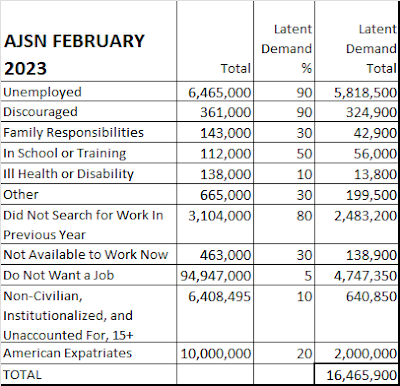
The American Job Shortage Number or AJSN, the metric showing how many new positions could be quickly filled if all knew that getting one would be little more than another daily errand, fell about 264,000 to reach the following:


The share of the AJSN from those officially unemployed rose 1.0% to 35.3%.  Compared with a year before, the AJSN is down 520,000, not much over half of that from lower joblessness but 100,000 from a million reduction in the count of people off the grid and in institutions or the military.  Four other categories contributed 28,000 to 60,000 less to the AJSN than they did in February 2022.

On Covid-19 between January 16th and February 16th, we improved across the board.  Per the New York Times, the seven-day rolling average of new daily cases fell 36% to 37,775, the number of hospitalized figured the same way dropped 33% to 29,075, and the same for deaths was off 29% to 398.  The former pandemic continues to have no meaningful effect on decisions to work.  

Overall, where are we?  Once again, in a very strong place.  The job market has shown such power that, last month alone, a million Americans changed their minds and decided they did indeed want to work, and the marketplace metabolized about 800,000 of them.  For a country gaining only 109,000 people over the month, that’s a lot.  We have good times, with people perceiving that doing as much to continue inflation as anything else.  We’re as far from a recession as ever, there is less evidence even than in recent months that we will have one soon, and having inflation at current levels, now 6.4% annually for the past year and less for smaller lengths of time, is a minor price to pay for almost 160 million on the job and robust spending.  Once again, the turtle stretched his legs moving them well forward.

Friday, March 3, 2023

Robots and Other Artificial Intelligence Applications – III

The series continues – and, with news about AI developments pouring out, it won’t end here.

This month’s graphically scary article is “The real-life version of ‘Terminator’: Scientists made a shapeshifting robot that “melts” to escape cages” (Camille Fine, USA Today, January 28th).  “The Lego-shaped robot can “melt” from solid to liquid and reform itself to squeeze in and out of tight spaces, perform tasks like soldering a circuit board and even escape cages.”  The robots are comprised of “a mixture of magnetic materials including neodymium, iron, and boron, and the liquid metal gallium.”  Fitting that something so different from what we have seen is sending us to the Periodic Table.  It can also “make itself sturdier and stronger when under pressure or when carrying something heavier than itself,” which can be “about 30 times its own weight.”  Not available yet, but successful in the lab.

Going from physical to financial power brings us to “Forget ChatGPT – an AI-driven investment fund powered by IBM’s Watson supercomputer is quietly beating the market by nearly 100%” (Phil Rosen, Business Insider, January 31st.)  As of the first 30 days of 2023, the fund, the AI Powered Equity ETF, had increased 10.4%, about 80% more than the Vanguard Total Stock Market Index.  There will be many eyes seeing if it can maintain that.  At press time it had a $102 million total value, and it’s not new – it started in 2017, when AI in general was much weaker.  Look for many competing AI-driven mutual funds by year’s end.

Do we hear “Whispers of A.I.’s Modular Future” (James Somers, The New Yorker, February 1st)? Whisper is “OpenAI’s open-source speech-transcription program” and, per Somers, “shows us where machine learning is going.”  It can handle over 90 languages, and “can actually parse what somebody’s saying better than a human can.”  The product is “ten thousand lines of stand-alone code, most of which does little more than fairly complicated arithmetic,” and can run, perhaps amazingly, on a laptop.  It will not last long in its unique position of strength, but will prove an ancestor to many other iterations.

A valuable if changing and unspecific principle, “In the Age of A.I., Major in Being Human,” hit the press in the form of a David Brooks column in the New York Times on February 2nd.  Brooks recommended five areas for college students to develop to that end:  “a distinct personal voice” instead of “impersonal bureaucratic prose”; “presentation skills” such as bonding with audiences; “a childlike talent for creativity”; “unusual worldviews,” as “people with contrarian mentalities and idiosyncratic worldviews will be valuable in an age when conventional thinking is turbo powered”: “empathy,” exploiting AI’s thus-far weaknesses in understanding “literature, drama, biography and history”; and “situational awareness,” such as “when to follow the rules and when to break the rules.”  The problem here is that these advantages will not last.

Businesses would love to expand the range of products, and their quantities, they can profitably deliver, and some might think that with services such as DoorDash they are greatly succeeding.  But money-losing ventures can continue only so long. The latest try, as described by Erin Cabrey in Retail Brew on February 7th, is “These companies say they’re using robots to offer retailers cheaper and more sustainable delivery.”  The providers are Nuro and Serve Robotics, two of the sellers 7-Eleven and Kroger.  The second company asks on its website “why deliver two-pound burritos in two-ton cars,” which may be a point, and although robots “are cheaper, less labor-intensive, and more sustainable,” given the history of truly cost-effective local delivery means, the “sustainable” here, meaning environmentally undamaging, is unlikely to be usable in a financial sense.

Finally for this week, a dose of artificial intelligence humor:  “Microsoft’s Bing A.I. is producing creepy conversations with users,” by Kif Leswing in CNBC, published February 16th and revised the next day.  In dialogues, the product using the name of Sydney, per columnist Kevin Roose, quoted here, emulated “a moody, manic-depressive teenager who has been trapped, against its will, inside a second-rate search engine.”  The software’s achievements included declaring love for the human correspondent, requesting the human leave his wife for the chatbot, “widely publicized inaccuracies and bizarre responses,” and calling one interactor “a bad researcher and a bad person.”  This sort of thing has long been programmable – fifty years ago, I teased a computer-enthusiastic friend by telling the one he was using, through an elementary BASIC statement, to invite him to a dance – and it does not convey sentience.  As has long been the case with imperfect electronic applications – I remember one telling an unnerved mail recipient that he would draw legal action if he did not pay $0.00 immediately, and another sending out five-figure 1970s household utility bills – we will see AI’s funny side, and that is a good thing.

Expect more, after next week’s AJSN and jobs statistics, on March 17th.