Friday, October 27, 2023

Artificial Intelligence is an Awfully Wobbly Juggernaut

For something that was supposed to be taking over the world, AI is tottering.  I can’t speak for the status of the technology itself, but that’s not the issue.  How it progresses and what it ends up doing will be decided in other realms:  legal, financial, social, regulatory, and more.  What’s been happening with AI prospects over the past two and a half months?

The first clue was in Futurism, updated on August 11th, “AI Is Starting to Look Like the Dot Com Bubble.”  This piece, modified by Maggie Harrison, started “as the AI industry’s market value continues to balloon, experts are warning that its meteoric rise is eerily similar to that of a different – and significant – moment in economic history:  the dot com bubble of the late 1990s.”  It is not that no companies are profitable – the hugest ones of Microsoft, Meta, and Amazon are – but there are many others, getting venture capital, which “have yet to even introduce a discernable product.”  It is time to realize that while there may well be Fords and Chevrolets, there will be Stutzes and Hupmobiles as well.

Per Ian Prasad Philbrick in the August 27th New York Times, “Regulating A.I. Requires Congress to Act Nimbly.”  The author pointed out that “major federal regulation” has taken as long as 90 years to materialize after “invention or patenting,” with nuclear energy, with the shortest interval, still taking four years, and airplanes and automobiles 20 and 70 respectively.  Although our senators and representatives have attended informational sessions, it is a challenge, and will take “perhaps a decade or more.”

A strong indicator of how people’s attitudes can trump technical achievements was in the September 10th New York Times, Kashmir Hill’s “Anonymity Is Over.  Big Tech Tried to Save It.”  It related how, six years ago, Facebook technologists worked out a way to identify faces and attach names and other information to them.  A related thing had been developed by Google in 2011.  Neither was released, as Google “decided to stop” what it was doing, and Facebook considered it “too dangerous to make widely available.”  Some are now using related facilities, but far fewer than their utility and technical merits would justify.

On the recent idea that artificial intelligence will at least help productivity, Aaron Mok, in Business Insider on October 2nd, relayed that “OpenAI’s ChatGPT can actually make workers perform worse, a new study found.”  The research, from Boston Consulting Group, found that when people used ChatGPT with GPT-4 for work requiring capabilities the software was known to have, such as “brainstorming innovative… concepts, or coming up with a thorough business plan,” the tool excelled, but on “more open-ended tasks” such as offering business recommendations, it would make large errors, dangerous “because the  consultants with AI were found to indiscriminately listen to its output – even if the answers were wrong.”  It will be a challenge for businesses to distinguish between these two rough categories.

There were things to think about in “Knowledge vs. intelligence amid the hype and hysteria over AI” (Mihai Naden, Fox News, October 2nd).  Naden considered intelligence to require not only evidence of ability to perform, but also what of two resources they required.  As “to win a game of chess at the expense of energy that a small town consumes in a week is unsustainable,” “artificial entities could justifiably claim intelligence if, in executing a task, they would use as much energy or less, and as much data or less, than a living entity performing the same task.”  That may be the criterion we need.

On the positive side, we have Paul Krugman’s October 3rd New York Times “A.I. could be a big deal for the economy (and for the deficit too).”  Although he saw generative AI as “souped-up autocorrect,” he thought it could massively improve productivity in that role.  He included a Goldman Sachs chart with 23 different industries, each divided into “no automation,” “AI complement,” and “likely replacement” of workers.  The field faring best was “building and grounds cleaning and maintenance,” with about 95% of employees in the first category, and “legal” the worst, ripe for a 40% job loss.  Some areas, such as sales, education, social services, and computers, were 100% complemented.  Of course, this does not include other sources of automation, globalization, and efficiency.

Per Ed Zitron in Scientific American on October 17th, “AI Is Becoming a Band-Aid over Bad, Broken Tech Industry Design Choices.”  He said iPhones came with 38 apps, 27 of which could be removed, and users would likely add more, but Apple is relying on AI interfaces instead of ones users could handle themselves, leaving “a Matryoshka of bolted-on features.”  Other vendors, according to Zitron, are similarly at fault.  Not an AI problem as such, but something to affect its reputation.

On October 18th in the New York Times, Kevin Roose said that “Maybe We Will Finally Learn More About How A.I. Works.”  Developers have communicated poorly about how the software was formed, including its use of copyrighted material and how it shares data.  GPT-4 got a 40% “transparency score,” not far off the 54% maximum among ten popular models.  Is it true or false that “we can’t have an A.I. revolution in the dark.  We need to see inside the black boxes of A.I., if we’re going to let it transform our lives”?  That is for us to decide.

Most recent is a reminder that, even for the largest companies, “Long on Hype, A.I. Is No Guarantee for Profits” (Andrew Ross Sorkin et al., The New York Times, October 25th).  Although both are deep into the technology, Microsoft has done far better than Alphabet since their earnings reports the day before, with a one-day 3.9% increase instead of a 6.2% decrease.  And Meta’s stock suffered the same day for other reasons.  So, it’s not enough to identify Ford or General Motors by their products – they must make money as well.  About that, we still, ample attention notwithstanding, do not know.  By the same token, we cannot see where artificial intelligence will wind up – regardless of our hopes and fears. 

Friday, October 20, 2023

Remote Work: The Con Side, From Writers This Summer

The issue of employees doing their tasks from the office or elsewhere keeps rolling on.  I won’t say it’s evolving, as I have maintained that its favor has been a pendulum, but it’s still oscillating.  Here is some input from commentators taking the negative view, which management mostly has now.

A remote-work effect adverse but not quite the responsibility of those causing it is the subject of “Middle America’s ‘doom loop,’” subtitled “Work from home is crushing Midwestern downtowns,” by Eliza Relman in Insider on June 22nd.  The author blamed less activity there on civic decisions made to emphasize businesses, and called on those administering such areas to adapt to this change, as “economists and urban planners say many Midwestern cities need to get serious about improving amenities and boosting quality of life in their downtowns.”

Could it be that “In the war over remote work, companies are turning full-time jobs into low-paying gigs” (Aki Ito, Insider, June 27th)?  Ito claimed that “employers are quiet quitting on the whole idea of traditional full-time employment,” as, per recent research, “businesses said remote work had led them to stock up on part-time employees, temps, independent contractors, and outsourced positions both at home and abroad.”  That trend was getting press late last decade, and has a certain justification, as, since worker’s performance issues are less important or drop out entirely when they are not conventional employees, working from home is especially compatible with such agreements.  These arrangements, as Ito points out, are not always negative, so this piece may not qualify as being against non-office work at all.

“For remote workers, time to get out of the house” by Isabella Aldrete on June 30th in Benefit News, deals with a problem people may not even know they have.  “About a third of employees say they struggle to leave the house enough when working remotely,” meaning that “work-life balance” is not only for those going to offices.  Per one interviewee, it would help them to realize “it can be important to really find time to just kind of completely unplug, leave… and focus on life outside of work,” as “it is really important to set and maintain those boundaries.”  Yes, that’s important.

The July 15th Economist had an article titled “The WFH showdown,” as “the fight over remote working goes global.”  “With bosses clamping down on the practice, the pandemic-era days of mutual agreement on the desirability of remote work seem to be over” – and, after naming various international examples, “the gap between the two sides of the work-from-home battle may yet narrow.  The question is whether the bosses or the bossed will yield the most.”

Finally, related to the second piece above, is “Remote workers are treating their jobs like gig-work, and it’s turning them into the most disconnected employees” (Jane Thier, Fortune, August 26th).  The author recommended “a hybrid plan,” and largely attributed the problem to modern work issues in general, with special concerns about “engagement and empowerment.”

Although I am still broadly bearish on remote work, these pieces, given that they were the most pertinent over the past four months, offered little new.  That probably means that not much has changed.  Since the Clinton administration, the pendulum has swung and the sides have disagreed.  Until businesses find an antidote, the issue of where to work will not be resolved. 

Friday, October 13, 2023

The Past Year’s Union Going’s-On, Ending with Automakers

During the previous twelve months, there have been a fair number of events and observations pertinent to organized labor, some of which have set the stage for the 2023 strikes.  What were they?

Before Joe Biden joined the United Auto Workers picket line, views on his attitude about unions were often different, as “Some Rail Workers, Seeking Sick Days, Say Biden Betrayed Them” (Noam Scheiber, The New York Times, November 30th).  Then, the president “urged Congress to impose a labor agreement that (one) union had voted down,” which led to a possible railroad strike, which he said “would threaten hundreds of thousands of jobs and… cost the economy more than $2 billion per day,” not materializing.  The main area of controversy was paid time off for illness or medical appointments.

Moving to a large, familiar company, which has had labor organizing efforts both successful and unsuccessful, was “At Starbucks, Schultz Is Back to Fight a Union” (Noam Scheiber and Julie Creswell, The New York Times, December 11th).  The former and incoming CEO named in the title gave “new benefits and wage increases but withheld them from employees in the union, which represents about 2 percent of the company’s U.S. work force of more than 250,000,” and said “no” to someone asking him “if he could ever imagine embracing the union.”

Times have changed significantly since December 17th, when The Economist published “Picket lines and poké,” subtitled “Unions are gentrifying.  Can that reverse their decline?”  Its main idea was that “unions used to be associated with brawny middle-aged men standing outside factories” but as of article time “the most active trade unions represent workers who have degrees and wear white collars,” 46% of whom had four-year degrees.  That may have been the main story of organized labor over the previous ten years, but it has since shifted toward protecting employees, especially lower-paid ones, from problems managements will not solve.  Moving in that direction, “Unions won more elections in 2022 than they have in nearly 20 years” (Vox.com, December 25th), with 641, or 80% more than in 2021.  As well, “unions are winning more than three-quarters of their elections,” “three times as many US workers went on strike in 2022 as in 2021,” and “the share of Americans who approve of unions is at its highest level since 1965.”  In addition, “US labor strikes surged 52% in 2022, showing rise in ‘worker activism’: study” (Brock Dumas and Bradford Betz, Fox Business, February 21st). 

Just into this year we saw as “Amazon Loses Bid to Overturn Union Victory at Staten Island Warehouse” (Noam Scheiber and Karen Weise, The New York Times, January 11th).  That decision was made by “a regional director of the National Labor Relations Board,” who “found that there was a lack of evidence to support Amazon’s claim of election improprieties.”

The conflict at the coffee-serving company continued, as “A barista fought to unionize her Starbucks.  Now she’s out of a job” (Greg Jaffe, The Washington Post, June 18th).  This article, which made the top of the Sunday front page, related how someone, who had worked there “for nearly eight years,” as she “was one of 49 baristas from across Buffalo who sent a letter to the company’s chief executive in August 2021 informing him that they were seeking to form a union,” was fired.  As of the publication date, there were “about 320 unionized Starbucks stores in the United States,” but the effort at this one failed.

Finally, are we in “Striking times” (The Economist, September 16th)?  The United Auto Workers stoppage, started one day before this publication date, was enlarged two weeks later (U.A.W. Expands Strikes at Ford and G.M.”, Neal E. Boudette, The New York Times, September 29th), and is still in progress, with companies laying off workers and no reports of successful negotiations.  There will be more.  Whether justified or not, beyond any doubt the labor situation is evolving more quickly than it has for decades.  In a year we may know much more, but for now, we don’t.

Friday, October 6, 2023

Jobs Report: Another Banner and Expectation-Exceeding Month, with AJSN Showing Latent Demand for Positions Down Over 600,000 to 16.2 Million

Another month, another jobs report, another big winner.  Why do I say that?

First, we blew away the published forecast of 170,000 net new nonfarm payroll positions with 336,000 – almost double.  Second, we added 242,000 employed people to reach 161,669,000.  Third, those were accomplished with private nonfarm payroll wages going up only 6 cents per hour, to $33.88 – less than inflation.

Much of the rest broke even, including the seasonally adjusted unemployment rate at 3.8%, the adjusted number of officially jobless at 6.4 million, the labor force participation rate at 62.8%, and the employment-population ratio at 60.4%,  Others which did change included the unadjusted unemployment rate, down a seasonal 0.3% to 3.6%, the number of those jobless for 27 weeks or longer improving 100,000 to 1.2 million, and the count of those working part-time for economic reasons, or keeping such positions while looking thus far unsuccessfully for full-time ones 100,0000 better at 4.1 million.  The only discouraging number of the ones I consider front-line is the number of people not wanting a job, up 729,000 to 94,411,000.

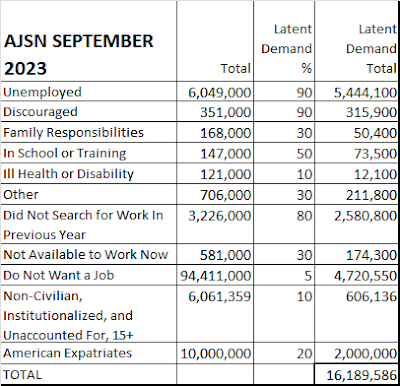
The American Job Shortage Number or AJSN, the metric showing how many additional positions could be quickly filled if all knew they would be easy to get, fell a remarkable 621,000 to reach the following:


Five-sixths of the drop was from official unemployment, with another 138,000 from a lower count of those wanting work but not looking for it during the previous year.  None of the other factors added or subtracted more than 37,000.  With lower unemployment, the share of the AJSN from official joblessness came in at 33.6%, or 1.9% less than in August. 

Compared with a year before, the AJSN gained 223,000, with the 530,000 more contributed from higher unemployment mostly offset by improvements in the counts of those discouraged, those wanting work but not looking for a year or more, and non-civilian, institutionalized, and off-the-grid people comprising about one-eighth less than in September 2022.

Perhaps, with unemployment and workforce participation the same and more people getting on the shelf, September was not as good as I thought.  But, with so many new jobs added and once more no reasonably clear movement toward recession – not to mention noninflationary wage increases – we should take this data as a solid indication of continued prosperity.  As before, even if it means we are treading water, it’s plenty warm.  The turtle, once again, took a good step forward.

Friday, September 22, 2023

Friday, September 15, 2023

Artificial intelligence, as Summer Wraps Up

What has been written about AI since late July?

First, we had “4 careers where workers will have to change jobs by 2030 due to AI and shifts in how we shop, according to a McKinsey study” (Jacob Zinkula, Business Insider, July 28th).  The areas are “office support, customer service and sales, food services, and production work (e.g. manufacturing).”  The emphasis here is on “lower-wage jobs,” with “clerks, retail salespersons, administrative assistants, and cashiers” each expected to lose more than 600,000 positions, net, in the next seven years.

Kevin Roose spotlighted one apparent area of early adoption in “Aided by A.I. Language Models, Google’s Robots Are Getting Smart,” in The New York Times on the same date.  He started by describing an automaton responding to “pick up the extinct animal” by doing so with a dinosaur model instead of a lion or a whale, a seeming merger between AI and robotics, and meaning that much more along that line would also be possible.  Additionally, we have, per a Google scientist, such devices discovering “how to speak robot” by guessing “how a robot’s arm should move to pick up a ball or throw an empty soda can into the recycling bin.”  When machines do these things consistently correctly, which they do not yet, they will be especially valuable.  The next day the Times published Ben Ryder Howe’s “The Robots We Were Afraid of Are Already Here,” which was disappointing, as there seemed little new here among these automata’s industrial capabilities.

A subject we would all like to succeed at is “How to invest in AI” (Kim Clark, Kiplinger, July 29th).  Since February, people expecting to be hugely important have long since pushed up some stocks and have done much more trading as developments and even plans have materialized, so we’re way up from any ground floor.  It’s reminiscent of buying automotive stocks in the 1920s, when knowing the industry had great potential did not mean we knew who the winners and losers would be.  Given that, though, there are industry leaders looking less risky than others – ones Clark named were chip designers Nvidia, Broadcom, and Taiwan Semiconductor, along with chip software maker Synopsis.  All are risky, but huge-potential investments always are. 

Controversy stepped into an area in progress for years, as “This tech is the ‘sad reality’ of restaurant industry’s future, business owner says robot works 12 hours a day” (Hannah Ray Lambert, Fox News, August 13th).  When an Estacada, Oregon eatery, in response to not finding enough servers, deployed a Plato automaton to do their work, the owner got “customer pushback.”  Strange, but may prove to be common. 

Expecting the technology to be stronger, not weaker, than people thought months ago, was Arantza Pena Popo, in “AI is going to eliminate way more jobs than anyone realizes” (Insider, August 14th). The author said that “permanent mass employment can safely be ruled out,” but hundreds of millions of people may not be able to work their current jobs in 35 years or less.  Beyond that, it’s just a great mass of unknowns.

A question on the minds of most in this field is “The U.S. Regulates Cars, Radio and TV.  When Will It Regulate A.I.?” (Ian Prasad Philbrick, The New York Times, August 24th).  Per Philbrick’s determination, it “probably won’t happen soon,” as while television was regulated within five years of “invention or patenting,” radio took 20, telephones took 30, and railroads and automobiles were not delimited until 60 and 70 years later.  While “regulation often happens gradually as a technology improves or an industry grows,” “sometimes it happens only after tragedy.”  Accordingly, it may, or may not, take a while.

Related to my post suggesting similar things four days earlier was “The A.I. Revolution Is Coming, But Not as Fast as Some People Think,” by Steve Lohr in the New York Times on August 29th.  Reservations and reasons for going slower named here are “risks of leaking confidential data, questions about how the data is used and about the accuracy of the A.I.-generated answers,” and it cited another McKinsey study suggesting “mainstream adoption” would take somewhere between 8 and 27 years.  By then, other problems, such as copyright infringement, may still be significant.  So don’t expect anything big for a while – but let’s still stay tuned.

Friday, September 8, 2023

Liking Remote Work Won’t Change Its Downward Trend

Although I think the working-from-home cons have more merit than the pros, there have been a significant number of articles favoring the latter.  What do they have to say?

Hiding his opinion even less than I do mine was Gleb Tsipursky, in the May 8th Fortune piece “Why your boss is giving in to the siren call of the return to the office – and giving up on the flexible work gold mine.”  The author called the idea that “many organizations are struggling to foster strong communication, collaboration, and team bonding” when people worked remotely “startling,” and said that companies, as they became “faced with challenges,” “rather than learning to adapt,” were “tempted to go back to the cozy confines of the office-centric model.”  The piece offered no substantive suggestions for improvement, only that management should overcome “status quo bias” and “functional fixedness,” “adopt methods of building culture, collaboration, team bonding, and communication that are a good fit for a hybrid environment,” and “stop running” from “the future of work,” which is “here.” 

Paul Krugman, the columnist and Nobel-winning economist, told us, in “Working From Home and Realizing What Matters,” in The New York Times on May 22nd, that the value of remote labor should be raised in our estimations, because of reduced commuting time, which is undercounted or not counted in other measures.  True – if work hours are no longer.  The same author had “Remote work hasn’t doomed cities.  It may even help them” in the same publication on June 2nd.  His thought here was that “people who don’t have to commute to the office every day spend more time frequenting local shops, restaurants and so on, improving the quality of their neighborhoods,” although “remote work will surely shift metropolitan areas’ centers of gravity away from their central business districts.”

Similar in tone to the first article, Breck Dumas wrote in Fox Business about “Why some bosses hate remote work and what can be done about common gripes” (July 17th).  The five major reasons the author saw were “inadequate communication and collaboration” (which called for managers to “reach out to their remote workers and stay connected with them in other ways, like through phone or video calls”), “task allocation and clarity” (by setting SMART – specific, measurable, achievable, relevant, time-bound – parameters), “time management” (by “providing workers with training on time management techniques and encouraging prioritization and delegation”), “workload and resource allocation” (“regularly assess workloads, redistribute tasks as needed and ensure individuals have access to the necessary tools, training and support”), and “recognition and reward” (find ways of celebrating achievements with “elements of fun,” even on Zoom calls). 

Finally, some advice on “Making a successful data-driven transition to hybrid work” (Louis Blatt, Benefit News, August 1st), namely to “find out what your employees need” and “give workers some space,” along with habitually “explicitly dividing your project management into two categories:  focused/individual work and collaborative work.” 

How did you like the above?  If you did, you’re probably in favor of plenty of remote work.  If you didn’t, you saw blitheness, vagueness, superficiality, and confusing training with individual performance.  The pendulum between in-person and remote labor is still moving – it is now pulling strongly toward the office.  If it were not, there would be few calls for workers to come back, and little controversy about it.  Dressing as vegetables on celebratory video calls won’t change that.  Assuming that everyone will be focused and conscientious when faced with the temptation of being unsupervised won’t alter its back-and-forth nature.  That’s not only the present, but the future of work.  That’s what we have known since the first George Bush was president – and what, indefinitely, we will continue to know.