Friday, June 10, 2022

Artificial Intelligence and Robots Keep Progressing, Like It or Not

Inflation and the pandemic have been the two largest American 2020s news stories, but not all.  Before they, and the Ukraine war, took over the headlines, another combined area gathered much more attention.  As it will remain critical after these three other situations have passed, let’s check in.

Artificial intelligence has been the toddler of technology, capable of much more than its governance can handle.  In “Clearview AI settles suit and agrees to limit sales of facial recognition database,” by Ryan Mac and Kashmir Hill in the May 9th New York Times, we learned about how this company, which uses “its database of what it said were more than 20 billion facial photos,” will no longer work with “most private individuals and businesses in the country,” but will still “sell that database to federal and state agencies.”  This decision stemmed from a 2020 American Civil Liberties Union lawsuit, which Clearview AI ended “to avoid a protracted, costly and distracting legal dispute with the A.C.L.U. and others.”  It can still be used by the likes of police departments, and the technology will remain.

Along similar data-collection lines, we have “Your Bosses Could Have a File on You, and They May Misinterpret It” (Sarah Scoles, The New York Times, May 17th).  Here, the ability to collect and integrate information has surpassed its prudent use, as “some private enterprises may be attracted to scrutinizing employees like an intelligence agency might keep tabs on analysts and spies,” since “software can watch for suspicious computer behavior or it can dig into an employee’s credit reports, arrest records and marital-status updates,” and it “can check to see if Cheryl is downloading bulk cloud data or run a sentiment analysis on Tom’s emails to see if he’s getting testier over time.”  This sort of thing, with poor or no established handling practices, being subject to unsettled laws, and as in the ACLU example ripe to easily run afoul of others with more power, is going to cause plenty of trouble before it achieves huge gains.

While still often controversial, physical AI applications are marching on.  One was described in “Robotic surgery is safer and improves patient recovery time,” from University College London on May 15th in Science Daily.  This was a formal writeup of an academic study showing that “robot-assisted surgery used to perform bladder cancer removal and reconstruction enables patients to recover far more quickly and spend significantly (20 per cent) less time in hospital.”  Here, “researchers say the findings provide the strongest evidence so far of the patient benefit of robot-assisted surgery.”  Although robots have helped with surgery before, such research results are where such things begin widespread legitimacy and implementation.

“What’s holding back the self-driving car revolution?”  This obvious query was posed by Mike Bebernes in Yahoo Finance on May 19th.  He said “the simplest reason” was that “driving is much more complex and difficult to replicate than automakers anticipated,” especially in dealing with “unexpected situations.”  Others he proposed were auto companies “rolling untested self-driving features onto the road and making lofty claims that prompt drivers to push beyond their vehicle’s capabilities,” and “the task of creating cars that can navigate every imaginable road scenario may simply be impossible.”  The second problem here is of marketing, but the first and third were supposed to be solved with efforts beginning with dedicated testing grounds and billions of dollars of purchased brainpower.  As one cited observer put it, “unless the industry and public agree to accept a flawed self-driving system – one capable of failure – autonomous vehicles on our streets will never become mainstream.  Achieving perfection here can’t, and shouldn’t, be the goal.”  That is the real issue, which boils down to a lack of tolerance, a lack of perspective in underemphasizing the most recent years’ 42,000 American human-driving deaths, and a lack of will.  There is no imaginable way that, given the possible things that could have gone wrong, we could have overcome a similar attitude when, for example, getting to the moon. 

How are sales of automatons doing now?  Just fine, as “US robot orders surge 40% as labor shortages, inflation persist” (Lucas Manfredi, Fox Business, June 1st).  It makes clear sense, as if workers need higher pay they open a door for alternatives, which can improve and cost less over time.  The industries with substantial increases were metals; plastics and rubber; semiconductor, electronics and photonic; food and consumer goods; and “all others.”  Expect more.

A well-established Japanese nursing-home idea has making stateside inroads.  As described in “Therapy with a robot?  How AI could help those struggling with mental health” (Michael L. Diamond, Asbury Park Press, published in Times Herald-Record on May 26th).  Sort of like 1990s Furby toys, called MARCos, “short for the mental health assisting robot companion,” they are “soft and cushy with two nonjudgmental eves and no mouth,” and look “like your favorite stuffed animal from childhood to whom you told your secrets.”  These devices “can respond, listening for key words to dispense advice or alert your contacts in case of an emergency.”  At $499 to $720 and heading lower, they are cost-effective if they achieve customer acceptance – and of course they can continue to improve.

Finally, “Farm Robots Will Solve Many of Our Food Worries” (Amanda Little, Bloomberg.com, June 2nd).  They “use computer vision to distinguish between crops and weeds and then deploy with sniper-like precision tiny jets of herbicide onto the weeds.”  Currently “expensive, enormous, wildly complex machines currently accessible only to industrial-scale farmers,” with enough demand they will get cheaper and smaller, and “within a few years their impact on the environment and human health could be nothing short of spectacular.”  More progress with the usual massive potential – that’s once more the story with robots and artificial intelligence.

Friday, June 3, 2022

Employment Report: New Jobs Healthy, People Rejoining Labor Force, AJSN Says We’re 16.4 Million Jobs Behind

This morning’s Bureau of Labor Statistics Employment Situation Summary turned out close to what people expected – almost. 

We gained 390,000 net new nonfarm positions, reasonably near the two 325,000 projections I saw.  Seasonally adjusted unemployment did not reach the 3.5% some thought, but held at 3.6%, actually increasing a bit with the difference falling into rounding – the unadjusted figure gained 0.1% to 3.4%.  Other indicators were mixed.  The adjusted count of those officially jobless rose 100,000 to 6.0 million, with 43,000 fewer or 810,000 on temporary layoff, and the number in long-term unemployment, or out for 27 weeks or longer, 100,000 better at 1.4 million.  The two measures best showing how common it is for Americans to be working or one step away, the labor force participation rate and the employment-population ratio, were up 0.1% and unchanged respectively to reach 62.3% and 60.1%.  The count of those employed, 158.609 million, was up 631,000, and that of unemployed also gained, 90,000 to 5.548 million.  Those working part-time for economic reasons, or holding that sort of position while seeking a full-time one, jumped 300,000 to 4.3 million.  Average hourly private nonfarm payroll wages again lagged behind inflation, gaining 10 cents per hour to $31.95. 

The American Job Shortage Number or AJSN, the metric showing how many currently unadvertised positions it would take to get one to each person who would grab it if they thought they were readily available, was up over 300,000 to reach the following:


The areas in which the AJSN got worse were people not searching for work in the previous year (adding almost 400,000 to the total) and those officially unemployed, contributing 81,000.  Improving were the count of those not wanting a job, contributing 52,800 fewer than in April, and the “other” category, with 47,100 fewer.  The share of the AJSN from those officially unemployed was almost unchanged, down 0.1%, to 30.4%.  Compared with April 2021 the AJSN again showed a year of great improvement, 3.5 million lower, with all but half a million of the difference from official joblessness and most of the rest from fewer people not looking for a year or more. 

On the pandemic side, per The New York Times, from April 15-16 to May 16 the seven-day average of new daily cases leaped 159% to 95,918, and hospitalizations were up 50% to 22,346 with vaccinations figured the same way off 33% to 371,272.  Deaths, though, fell 33% to 302, clearly telling us that the current variant is the least lethal we have seen.  Once more there is no indication from Covid-19 that people should be working less than they are. 

So what happened here?  The statistics above are unanimous in showing that many people tried to go back to work, starting with a one-million decline in those claiming no interest, and while most got there many did not.  The gain in people employed, along with the robust net new jobs count which is still around ten times what we need for population growth, tell us that our economy is strongly expanding.  Latent demand increased as more people are looking.  We still have a problem with wages, and the main reason for not finding jobs, and the boost in those working part-time for economic reasons, may be that existing opportunities pay too little.  That’s why the numbers above, for the strong and improving times we are in, look messy.  Employers still need to evaluate the cost of leaving needed positions unfilled against that of paying more – as they realize that the latter will allow their sales, in an outstandingly high-demand time, to jump even more, which will also shut up the misguided people talking about a possible recession.  There’s no doubt that the bones of our employment situation are strong, so, accordingly, the turtle took another solid step forward.

Friday, May 27, 2022

Inflation, Interest Rates, Recession, Stagflation, “The Era of Cheap and Plenty,” and Getting a Grip

Unjustified fears are hardly restricted to the far left or far right these days.  Consider our economic situation, which looms highest on American’s current concerns.

First, the one on which we can’t sensibly disagree.  In “Why Has the Inflation Calculation Changed Over Time,” by Stuart A. Thompson and Jeanna Smialek in the May 24th New York Times, we are reminded that the latest rate, April’s, is 8.3%.  That was down 0.2% from March.  The only algorithm adjustments the authors mentioned were 23 and 39 years ago, allowing items that could substitute for others and removing house prices, which means no special recent controversy.

Inflation is why “Fed officials expected to make at least three big rate increases over the next few months” (Ana Swanson, The New York Times, May 25th).  We have already had two such hikes, resulting in the federal funds rate still a historically low 0.75 to 1 percent, and Swanson, doubtless along with the Federal Reserve itself, has no firm timelines for the next, though the next meetings, scheduled for June 14-15 and July 26-27 per the Board of Governors calendar, seem probable targets.  There is real disagreement on whether these raises will solve our current problem, as it is not the usual inflation situation but caused by pandemic-related demand coupled with unusual supply problems, but the Fed is under bipartisan pressure to “do something,” and this is the only something they know.

We also need to keep in mind “What Higher Interest Rates Could Mean for Jobs,” as on May 17th, also in the Times.  Author Lydia DePillis concluded implicitly that they wouldn’t mean much at all, as “job losses would have to mount considerably before workers would have a hard time finding new positions, given the backlogged demand,” about 740,000 additional people must be hired every year to support house building, commercial construction is behind and in demand, and an outplacement company president reported that “a lot of our customers are trying to avoid the ‘fire and rehire’ playbook of the past.”  Therefore, in these areas and doubtless others, lower sales will not even eliminate shortfalls. 

What is a recession?  Per Oxford Languages, it is “a period of temporary economic decline during which trade and industrial activity are reduced, generally identified by a fall in GDP in two successive quarters.”  Even though the definition does not include employment, it would still require, from here, demand to significantly drop and stay lower.  Could that happen, with that now widely outstripping supply and healthy hiring and job creation?  Well, “A Harvard economist says the economy looks bad right now, but a recession isn’t a sure thing.  It all depends on these 2 factors” (Tristan Bove, Fortune, published in Yahoo Finance, May 12th).  Except for stock market activity, which since the publication date has been up and down instead of “crashing,” with 3.6% adjusted unemployment and household wealth strong it’s hard to defend that “the economy looks bad.”  This professor’s two things are consumer activity, already another good aspect of how we are doing, and his expectation that gasoline prices, due to higher production and large releases from the American strategic reserve, will fall.  Easy.  With there being no reason for jobs to go away, and in turn for consumer demand to plummet, I see almost no chance for a recession, by definition and in spirit.

Even further out is stagflation, described in Investopedia as being “characterized by slow economic growth and relatively high unemployment—or economic stagnation—which is at the same time accompanied by rising prices (i.e., inflation) … alternatively defined as a period of inflation combined with a decline in the gross domestic product (GDP).”  We have the third component, but where are the chances for the first two?  Still, “Ben Bernanke sees ‘Stagflation’ Ahead” (Andrew Ross Sorkin, The New York Times, May 16th).  Bernanke, a former good Fed chair, should know better, and maybe he does, as in the text he is only quoted as saying something could happen that “you could call” stagflation.  Perhaps, as he suggested, 4% unemployment (“up a little bit”) and 5% inflation (dropping due to fewer people working) would qualify.  If so, we spent most of the prosperous 1960s in stagflation. 

Finally, could it be that “The Era of Cheap and Plenty May Be Ending” (Jeanna Smialek and Ana Swanson, The New York Times, May 3rd)?  “The answer could hinge on whether a shift away from globalization takes hold,” although then we might have “more resilient, more robust supply chains,” something on the list of corporate managers all over.  With plenty of international connections still functioning well, changes seem likely to be incremental instead of fundamental, and for now, per the above, our country is not in long-term economic trouble either.  So, as with the other possibilities, let’s not worry about developments with minimal or nonexistent chances.  Inflation is real, and we need to continue reducing it, but recession, stagflation, and few low-priced goods are not worthy of your attention.  We have enough to worry about.

Friday, May 20, 2022

Transportation Developments Beyond The Usual: High Value, Varying Progress

Over a trillion dollars of the American gross domestic product goes to moving us around.  Being able to go almost anywhere safely is one of the great things about the modern age, and, over the centuries if not decades, has progressed greatly.  For 60 and 100 years respectively, jet airliners and gasoline-powered cars have dominated, but there is and could be more.

That most prosaic was the topic of Farhad Manjoo’s March 18th New York Times “The Holy Grail of Transportation Is Right in Front of Us.”  Although “in America, nobody loves the bus,” and its systems are “chronically underfunded,” they use existing roadways, are flexible, and its citizens took 4.6 billion trips with them in 2019.  From what he saw in London, Manjoo recommended increasing their numbers, to which I add something I too have seen overseas, electric signs at bus stops with expected arrival times.  If buses got even a sliver of the personal and legislative love of trains, we would benefit.

Onto a form that cannot complain about being unfavored: “Electric vehicle sales hit record high in 2021, KBB reports” (Erika Giovanetti, Fox Business, February 22nd).  Lyndon Baines Johnson was president when I first read about the great potential of electric cars, and their main problem, driving distance between lengthy charges, remains the same.  So I can’t get excited, after decades of subsidies and green enthusiasm, about seeing that sales of electric vehicles (not the same as personal automobiles) reached 4.5% of the market last year, with hybrids, the most adaptive version, below 10% of “the car sales market.”  Even if we sweep their higher prices under the rug, the implied and even touted environmental advantage is small, with an average of 35% of American electricity coming from fossil sources, meaning, as when hippies and Vietnam headed the news, they are still generally neither suitable nor desirable.

Electric car acceptance could be passed by something more recent and more fanciful, if it gets help.  In “Virgin Hyperloop unveils West Virginia as location for Hyperloop test center,” (Louis Casiano, Fox Business, October 8, 2020) we saw at least planned progress for this magnetic-driven 600mph ground transportation technology.  Yet, nine months later on July 16th, the same publication could only issue Chris Taylor’s “All aboard the hyperloop:  How your commute could be changing,” a how-this-works-and what-it could-do-someday piece that could have been issued two years before.  The hyperloop concept has been proven, and people years ago rode on it for half-miles and speeds of 200, so it’s time to move ahead – will it happen?

Something even more spectacular and ambitious has been implemented better.  First, “Tony Robbins puts money behind Cape Canaveral space balloon business” (Bradford Betz, Fox Business, December 3rd).  Pompous ass or not, this motivational speaker wants to actually do things more than most, and this one is actually in progress, with, per Debra Kamin’s May 7th New York Times “The Future of Space Tourism Is Now.  Well, Not Quite.,” seven “completed space tourist launches,” by Jeff Bezos’s Blue Origin, Elon Musk’s SpaceX, and Richard Branson’s Virgin Galactic, completed, and a fourth company, World View, taking and getting 2024 reservations for Robbins-style balloon trips, during which “a 10-person pressurized capsule… will gently float to 100,000 feet while passengers sip champagne and recline in ergonomic chairs,” “high enough to show travelers the curvature of the planet.”  I thought I had seen that from 30,000 feet at twilight, but I’m sure it’s better higher.  With no rocket and long-standing technology I don’t see a problem, and will skip over other of Kamin’s reported projections, as this industry is now, partially but indisputably, past the concept-and-testing stage.

That leaves us with driverless cars.  I ignore the incremental and extremely localized achievements, as in 2017 we were expecting autonomous vehicles to be all over the place, in favor of a more important and equally pertinent report.  It is “Newly Released Estimates Show Traffic Fatalities Reached a 16-Year High in 2021,” issued May 17th by the National Highway Traffic Safety Administration.  The tentative number was 42,915 – more than 21,000 times the total killed by driverless vehicles.  A lack of will is not only sad but can be deadly – and that goes for other transportation shortcomings as well.  

Friday, May 13, 2022

Inflation and Interest Rates: What Happened, What They Mean, and How We Can React To Them

The largest jobs-and-the-economy news story of 2022 is clearly here.  There has been almost too much coverage and commentary, even when it’s not politically distorted.  So let’s go to the core.

Per Jeanna Smialek’s May 4th New York Times “Fed raises rates half a percentage point, its largest increase since 2000,” the federal funds target level went up last week, though at 1.00% it is historically low, in fact under any point from before 1970 to 2002.  We should expect more such hikes, as Federal Reserve chair Jerome H. Powell said that “there is a broad sense on the committee that additional 50 basis points increases should be on the table at the next couple of meetings.”  The Bureau of Labor Statistics announced that “inflation edged down to 8.3% in April compared to a year ago, remaining near 40-year highs” (The Washington Post, May 11th), from 8.5% in March, suggesting that the rate, if still a major problem, is leveling off or decreasing.

One of higher prices’ less-publicized effects is that “Sky-high inflation could lead to higher taxes for millions of Americans” (Megan Henney, Fox Business, May 10th).  Since federal income tax became indexed in 1981, we haven’t thought much about “bracket creep,” the result of pay following higher prices being subject to percentage tax increases, but “15 states fail to account for inflation when drawing the brackets for taxes on wages and income” and “another 18 states do not index personal exemption tax to inflation.”  These locations are spread all over the country, and the first group includes high-population Georgia, New Jersey, and New York.  With the current problem small for four decades, this situation was given little priority, but expect that to change.

“What do Federal Reserve interest rate hikes mean for Main Street?” (Brock Dumas, Fox Business, March 16th).  That includes higher personal rates on “car loans, mortgages, and credit card balances,” but those for “savings accounts and CDs will rise at a slower pace.”  Discouraging, but to be expected. 

What else can ordinary people do?  The advice offered in “Gas prices could hit a new record high:  Here’s how to save” (Daniella Genovese, Fox Business, May 9th) is well-worn, but bears repeating:  “Lighten the weight of your car”; “Purchase a fuel-efficient car”; “Only use the air conditioning when you need it”; “Use cruise control”; “Don’t idle”; “Make sure your tires are properly inflated”; “use cash-back credit cards and… join a gas station loyalty program when possible.”  These things matter more than usual.  I add that when deciding whether to pay with cash or credit when the latter costs more, consider what your cash-back rate is, as often now the difference at the pump is less than 1%. 

A new opportunity, perfect for now, was described by Ann Carrns in the May 3rd New York Times: “Inflation bonds are earning eye-popping rates:  9.62 percent.”  Seems too good to be true, but these are legitimate Series I U.S. savings bonds.  They pay amounts algorithmically determined from fixed amounts and inflation levels.  They must be bought online, with limits of $10,000 per person plus a maximum of $5.000 more with tax refund money, “you must hold I bonds for at least 12 months before redeeming them, and you’ll be docked the last three months of interest as a penalty if you redeem before five years.”  If you don’t believe it, check out treasurydirect.gov and open an account for yourself to start the process, which takes at least ten business days.  I did.

In government policy as elsewhere, the strongest response is not always the best.  That was the idea of “The Courage Required to Confront Inflation,” by the New York Times Editorial Board on April 29th.  Points made in this piece include “supply shortages… are best endured patiently.  The Fed’s decision… won’t ease them,” “lingering questions about the health of the economy provide another reason for the Fed to move cautiously,” and “there is no evidence the United states is entering a wage-price spiral.”  Sellers are all too willing to get more products, and when the problems from supply-chain snags to Covid-19-caused foreign worker restrictions ease, they will come in no matter the interest rates.  In the meantime, jobs are plentiful and families have added a lot of money, two things we don’t want to endanger.  The course we are following is prudent and will prove effective – let us give it the time it needs.

Friday, May 6, 2022

Another Good Jobs Report, with AJSN-Shown Latent Demand Down Another 500,000 to 16.1 Million

After some wild Bureau of Labor Statistics Employment Situation Summary editions, it’s good in a way to see one that matched predictions and was consistent with common sense. 

The two projections I saw for net new nonfarm payroll positions, 380,000 and 390,000, were almost right on this morning’s 428,000.  There is a large usual difference between how many people are working in March and April, as while the seasonally adjusted employment rate held at 3.6% the actual or unadjusted figure fell from 3.8% to 3.3%.  Other key statistics were mixed.  On the good side, the count of officially jobless dropped 100,000 to 5.9 million, and the total of those working part-time for economic reasons, or holding on to that kind of work while seeking full-time opportunities, shed 200,000 to 4.0 million.  Losers were those on temporary layoff, up 66,000 to 853,000, those out of work for 27 weeks or longer, up 100,000 to 1.5 million, average private nonfarm payroll wages, up 12 cents per hour to $31.85 but well below inflation, and the two measures of how common it is for Americans to be working or one step away, the labor force participation rate and the employment-population ratio, down 0.2% and 0.1% to 62.2% and 60.0%. 

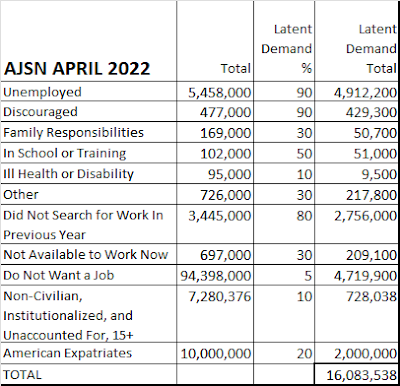
The American Job Shortage Number or AJSN, the measure of how many new open positions could be quickly filled if all knew they were routinely easy to get, lost 501,000 to reach the following:


The share of the AJSN from those unemployed by official definition is now 30.5%, down from 33.5%, meaning that almost 70% of nonworking people who would take freely available jobs have other statuses.  That is historically very low.  Compared with a year ago, the AJSN has lost 3.7 million, all but 300,000 of that from lower official unemployment. 

On the pandemic side, the 7-day average of Covid-19 cases increased 18% from March 16th to April 15th (data was not available for April 16th) to 37,003, the same for deaths down 63% to 466, people hospitalized for this ailment off 42% to 14,868, and total number of vaccinations, most commonly newly-available boosters, up 203% to 718,910.  Given the still-low if rising case count, the geographical concentration of recent activity, and most of all the plummeting death numbers, it is still clear that few are taking undue risks to stay on the job. 

How can we size up April?  In some ways we didn’t go anywhere – pay is still lagging behind inflation, more people left the labor force, and the shortest and longest joblessness figures worsened.  On the other hand, that 428,000, about ten times enough to cover our smaller population growth, is nothing to take for granted.  We’re doing well, though it is obvious where we need to improve.  This time the turtle took a medium-size step forward.

Friday, April 29, 2022

Ten Months on Robots, Automation, and Artificial Intelligence

Big topics, little communication.  My cupboard is not quite bare, but has some odds and ends, which are worthwhile, even if they add up to one post instead of the three these matters seem well worth.

Artificial intelligence, or AI, seems to be springing leaks, if not in how it is progressing but how people deal with it.  A stern view on one, by George Maliha et al. in Harvard Business Review on July 13th, was “To Spur Growth in AI, We Need a New Approach to Legal Liability.”  We hit the issue of which humans are legally responsible for post-algorithmic technology with driverless cars, which haven’t spread enough for anything resembling legal precedents, and here we have the straightforward assertion that “the existing liability system in the United States and other countries can’t handle the risks” it entails.  The authors recommend “revising standards of care” especially for medical AI applications, granting radiologists, for example, immunity from malpractice if they provide secondary image reading after AI provides the first; “changing who pays:  insurance and indemnity” including insurers giving better rates for professionals using favored AI systems;  “revamping the rules:  changing liability defaults” such as, if autonomous cars are involved, not automatically blaming a human driver in the striking vehicle for a rear-end collision;  “creating new adjudicators:  special courts and liability systems” using more sophisticated knowledge than most judges have;  and “ending liability completely:  total regulatory schemes” or institutionalizing knowledge that in some cases nobody is at fault.  A good start, all of this.

Julian Jacobs addressed another future problem area in the Brookings TechTank on November 22nd, with “Automation and the radicalization of America.”  Jacobs found that combining one study assigning mechanization potential to occupations with another giving demographic data on people working them told us that those more likely to be replaced by machines “tend to have a dark and cynical view of politics, the economy, the media, and humanity” and skew left on financial issues but slightly right on “socio-cultural ones.”  He stopped short of predicting revolutionary activity among these workers, but such, if they do indeed lose their jobs, could happen this decade or next.

“Will Robots Really Destroy the Future of Work?”  Peter Coy revisited this old overstatement in the January 24th New York Times, featuring an interview with labor economist David Autor, who “loves” both robots and unions and wants the two to be coordinated better, ideally on better-paying jobs.  Per Coy, such means realizing that “workers need training so they can use automation, not be replaced by it.”  I see no mention of the number of positions that we can expect to be lost, and it seems naïve to think it will not be substantial, even if some are created – the major point of mechanization is to reduce labor costs, which would not happen if almost as many jobs are created to work with it.  Now, as opposed to two years ago, we can better justify trading lower-paying positions for fewer higher-compensated ones, but there is hardly a guarantee 3%+-unemployment will last indefinitely.  Destroy, no – damage and change, yes.

The Writing on the Wall” was a long April 17th Steven Johnson piece in the magazine section of The New York Times.  The subtitle of sorts was “A.I. has begun to master language, with profound implications for technology and society.  But can we trust what it says?”  We’re now at the point where such a system can write good-looking essays proposing plausible solutions to complicated problems in a second or so, through abilities to determine missing words and access massive numbers of sites, not all truthful or prudent.  The core of this issue is that the machines themselves cannot judge written material and cannot always identify lies, meaning human input is still needed.  We also are not avoiding the issue of what AI language modules may produce without confidential influences, which could well offend or even upend modern sensibility.  Overall, Johnson’s view that “the very premise that we are having a serious debate over how to instill moral and civic values in our software should make it clear that we have crossed an important threshold” seems appropriate – and solutions may depend on specific assumptions such as “people are basically good” and “guns in houses are safe enough,” which could be revealed to all.  A long way to go we have, and this piece does help.

Shrinking to a less general concern, we have Tanya Moore’s April 19th New York Times “Can A.I. All but End Car Crashes?  The Potential Is There.”  We don’t have many autonomous vehicles, but there are plenty of others with related software – even my ordinary, year-old Toyota Camry beeps when I cross a center line.  Moore mentioned various other mechanistic improvements, and others in progress – this area is burgeoning.  That means that even if we don’t lose drivers, we will still gain a lot of safety and save many lives.

I end with a robot application with smaller import, but the kind which we can solidly expect.  It’s “Jack in the Box to pilot Miso Robotics’ Flippy 2, Sippy” (Lucas Manfredi, Fox Business, April 26th).  It will start in only one of the fast-food chain’s locations, and not until late this year, but the first of these “takes over the work for an entire fry station” at a 30% production increase, and the second cuts drink spills as it “efficiently moves cups,” “accommodates a range of cup sizes and groups cups by order for easy delivery to customers.”  At today’s rates, Flippy 2’s $3,000 per month is less than only one full-time fast-food worker, and will work many more hours.  Like it or not, if the trial works, it will propagate, help the business, and potentially save customers’ time and money.  Look for many more – and don’t forget these growing and evolving issues, as, headlines or not, they won’t leave us alone forever.