Friday, August 26, 2022

Unions: A Busy Month at Three Large Companies, with Two More That May Get There Too

In the six weeks since I posted on labor unions’ resurgence, there has been a flurry of news.

This headline firm, as reported by Ken Martin in Fox Business on August 12th, has a problem, namely “Amazon worker deaths in New Jersey under investigation.”  In the month before the article date, two employees there died clearly from workplace injuries, and a third did “potentially.”  That company has since had its second attempt in another state, as “NY Amazon workers file for union election” (Haleluya Hadero, Associated Press, published in Times Herald-Record on August 18th), adding to Staten Island the Albany-area town of Schodack.  Issues here included “better training,” and, this time, money, as a spokesperson said they had workers “unable to even make it to work because they can’t afford gas.”  The election, if approved by the National Labor Relations Board, would also be under new-and-growing Amazon Labor Union auspices.  Sad.

On August 5th, CNBC published a general update, “Unions are forming at Starbucks, Apple and Google.  Here’s why workers are organizing now,” by Katie Schoolov.  The first firm, though starting later than Amazon, has had the most locations with recent union activity, as the number of Starbucks coffee shops greatly exceeds that of Amazon offices and warehouses.  The Apple and Google efforts are “slower,” but Starbucks is jumping ahead, and baristas, to name those of one job title, “want a boost to the current starting salary of $15 per hour, more staffing where it’s needed and more say over their schedules,” along with “better benefits,” including “more comprehensive mental health benefits as well because working during a pandemic has been enormously stressful.”  In more specific news, we have “Starbucks accused by union of retaliation over closure of two locations” (Aislinn Murphy, Fox Business, August 23rd), these being in Missouri and Washington State and officially shuttered “over safety concerns,” and “Starbucks illegally withheld raises from workers at unionized stores, National Labor Relations Board complaint alleges” (The Washington Post, August 24th).  Unpleasant. 

A 530-location grocery store chain is joining the multiple club, as “Trader Joe’s Workers Vote to Unionize at a Second Store” (Noam Scheiber, The New York Times, August 12th).  This one’s in Minneapolis, joining one in Hadley, Massachusetts, with filing completed by another in Colorado.  They also have their own union, Trader Joe’s United, and have been spurred by dissatisfaction with pay, benefits, and a lack of “protocols or systems in place to handle certain emergencies,” especially in urban settings. 

To reinforce things I wrote about last month, we can see what’s happening here.  With labor in high demand, more and more employees not getting satisfaction with issues are choosing to stay and fight.  I don’t know the histories of how these problems moved from mentioned to causing an elaborate, lengthy, and charge-carrying process, but suspect that unionization was not the first step.  The safety issues are those generally resolved in American workplaces 30 years ago or more.  The monitoring, regulating, and often worker-squeezing ones may be out of line with our current economy, if not simply unreasonable.  The organizing has come so quickly that many companies have doubtless not been able to change quickly enough.

But here are two with no choice.  I wondered why certain shipping company employees dressed as if they were in the tropics; by reading “UPS Drivers Say ‘Brutal’ Heat Is Endangering Their Lives” (Livia Albeck-Ripka, The New York Times, August 20th) I found out.  Apparently an issue shared by Fed Ex and to some extent with the United States Postal Service, the results of the problems, including dehydration and heat exposure with in-vehicle temperatures way over 100 degrees, have included paramedic visits, hospitalizations, and even deaths.  United Parcel Service management is providing the likes of “cooling towels,” “water, ice, electrolyte replacement beverages and fruit,” along with more installed fans, but they will find out soon that that is not enough. 

UPS faces two choices – put air conditioning in all of their “smaller delivery trucks,” none of which have it, or face a blizzard of not only successful lawsuits but a great increase in unionization there, which has about half of its workers represented leaving 200,000 more.  Worse could be coming for FedEx, which has no drivers at all in unions.  If they do not want to turn up in articles such as the above, along with drawing bad public relations, UPS and FedEx will need to end this embarrassing situation.  Here, once again, decisions to unionize will not be made by the workers.

Friday, August 19, 2022

Jobs Quantitative and Qualitative – Numbers and Generations

Yes, there is more on this topic, some basic until you look underneath it.

When we read that “U.S. employers posted 10.7 million job openings in June, reflecting continued strength in the labor market with some signs of cooling” (The Washington Post, August 2nd), we might think that this decrease of a few hundred thousand means fewer good opportunities.  If anything, it means the opposite, that this mass of help-wanted listings is shrinking as deservedly-frustrated companies are filling them by paying current market rates.  As I wrote ten years ago in Work’s New Age, job ads no longer mean job hiring – with AJSN-documented latent demand hanging at around 17 million, that problem is even worse now.  As I have maintained since 2012, these so-called offerings, at least the sincere ones, will disappear with wage increases and removal of former wish-list attributes which have morphed this century into requirements. 

It makes some but not complete sense to be glad that “With Surge in July, U.S. Recovers the Jobs Lost in the Pandemic” (Lydia DePillis, The New York Times, August 5th).  True, there are as many American positions as there were in February 2020, but we haven’t yet got back to where we were going, forecasted to be a substantial net increase in the past 29 months.  Indeed, per “Can a hot but smaller labor market keep making gains in participation?,” by Lauren Bauer et al. in Brookings on August 4th, “pre-pandemic projections” had us adding, by now, “roughly three to three-and-a-half million workers.”   Efficiency marches on, and Covid-19 showed plenty of employers how to manage with fewer workers.  As well, it is worth noting from the DePillis piece that adjusted unemployment now matches that month’s 3.5%, and it and the total number of positions may well have more improvement ahead.

We know people born in the 1980s and 1990s had fewer economic opportunities in their youth, and, according to Derek Thompson on June 13th in The Atlantic, we are now seeing “The End of the Millennial Lifestyle Subsidy.”  The author’s idea was that this generation had the heaviest use of “Uber, the Uber-for-X clones, and that whole mosaic of urban amenities in travel, delivery, food, and retail that vaguely pretended to be tech companies,” as “almost each time you or I ordered a pizza or hailed a taxi, the company behind that app lost money,” meaning these firms “were paying us, the consumers, to buy their products.”  Thompson ran off eight concerns someone might use in one day, with total losses of “about $15 billion in one year.”  With less venture capital, higher interest rates making other loans more expensive, and supply chain problems causing “higher prices, higher margins, fewer discounts, and longer wait times for a microgeneration of yuppies used to low prices and instant deliveries,” the author opined, the change may be permanent, especially since, as I see it, these types of businesses have never been profitable.  So, what can millennials and other customers say, other than “it was fun while it lasted”?  At least they are in a fine job market.

Many of the following cohort and those close to it are old enough to start turning up in good-job workforces, and in this time of low unemployment are making themselves heard, as “Gen Z Knows What It Wants From Employers.  And Employers Want Them” (Alyson Krueger, The New York Times, July 31st).  People interviewed here valued L.G.B.T.Q. identity incorporation, employer acceptance of “piercings, tattoos, and colored hair,” opportunity to have remote shifts and a “four-day workweek,” mental health benefits, access to private clubs and company-owned social houses, and, showing that not all of their desires are peculiar to their generation, “career growth opportunities.”  There is no guarantee they will have the same wishes in 2032, but for now, organizations looking for more young-adult workers should consider fulfilling them.

After-school paid work for high-school students was big in the 1970s and before, but has since ebbed and flowed, hurt by economic downturns and college-admission apathy.  This July 31st New York Times piece, “The Best Extracurricular Is a Job” by Pamela Paul, named real reasons why it would be good for it to come roaring back.  She didn’t mention that some universities are now giving credit for applicants’ paid positions, but named “8 valuable things” she, a recent high-school graduate, got from them.  They were discovering that “being good at school doesn’t mean being good at work,”  “being fired isn’t the end of your career – and neither is quitting,” “you learn what it’s like to make minimum wage,” “you’re being paid for your time,” “promotions aren’t automatic,” “bosses can behave badly,” “being in a workplace means working with people who aren’t like you,” and “not everyone is as lucky as you are.”  Not only a first-rate antidote to younger people’s entitlement and insularity, but gets them money too.  I heartily endorse it.

Friday, August 12, 2022

Too Bad the Fed Has Only a Hammer – Inflation Isn’t a Nail This Time, and We’re Flourishing

There is a real problem understanding our economy out there, even among people whose knowledge is supposed to be nuanced.  Here are titles of articles published on August 5th, after that day’s tremendous jobs report:  “Unemployment Heads in the Wrong Direction for the Fed” (Jonathan Levin, Bloomberg.com); “Markets will be in for a ‘rude awakening’ following jobs report, economist warns” (Talia Kaplan, Fox Business); “Good News on Jobs May Mean Bad News Later as Hiring Spree Defies Fed” (Jeanna Smialek and Jim Tankersley, The New York Times); “The Fed will have to ‘break this economy’ to tame inflation after the strong jobs report, Mohamed El-Erian says” (Phil Rosen, Business Insider).  The wrong track was awfully crowded.  The only points go to Ben Casselman, for “How This Economic Moment Rewrites the Rules,” in the August 6th New York Times. 

What’s really going on?  It’s simple, and not bewildering at all.  The root cause of our economy’s state is way-high demand, from people cooped up and accumulating money during peak pandemic time and often additionally unable to buy because of manufacturing and supply-chain problems.  These eager consumers, when things cost more but what they want is available, are taking the push and buying anyway.

All of that, along with higher world demand for oil, makes prices go up, and, as more and more labor has been needed to produce and sell things, it has vastly increased the number of jobs.  We have too much money chasing too few goods and services, and too much demand for labor chasing too few workers, not to mention too many businesses refusing to pay what are now market rates for it – both classically inflationary.  The economy is excellent – the only thing out of whack is supply and demand.

So what about interest rate increases?  Because demand is so much less elastic now, they won’t be as effective as usual.  Instead of cooling the economy, they will be most successful at pushing stock prices down, multiplying the interest we pay on our over $30 trillion national debt, and perhaps even creating as much inflation as they eliminate by increasing corporate costs, which can be passed along.  The best thing we can do with inflation is to leave it alone – it will drop by itself when consumers get sated.  With reduced oil prices, down from $122 per barrel to $88 at one point, and falling food costs, that is happening already, as shown by July’s 8.5% reading, the lowest since April. 

Players of the game of bridge value their hands with “high card points,” assigning four to each ace, three to each king, and so on.  It is the best single evaluation tool there today.  But, although most advancing participants learn the need to use additional factors, many do not, and their games suffer.  That is the same way our otherwise eminent observers are now failing.  If we have inflation, they always seem to want to solve it with higher interest rates.  If we have clearly short-term Gross Domestic Product shrinkage due to not enough goods and services, even amidst a mass of other favorable numbers, it must be a recession.  If our job gains have blown away our population increase all year, there is work for practically anyone who wants it, and there is so much demand for travel that airports are putting limits on how many passengers they can handle, it must be “bad news.”

All of that is thinking for novices.  We can do better.  It is time for us to not only realize what is happening, but to adjust our attitudes and policy actions accordingly.  We don’t need to break anything.  That will help us, and is not too much to ask.

Friday, August 5, 2022

American Employment Just Keeps Getting Better: Even Lower Joblessness, Double the Projected Number of New Positions, People Rejoining Labor Force With Latent Demand per AJSN Still 17.0 Million

What a jobs report!

This morning’s Bureau of Labor Statistics Employment Situation Summary, anticipated as “key” and “critical,” could have disappointed nobody who honestly wanted it to improve.  It started with 528,000 net new nonfarm payroll jobs against a published 258,000 projection.  While the unadjusted unemployment rate stayed at 3.8%, the adjusted one, after three 3.6% months, dropped to 3.5%.  There were 5.7 million people officially jobless, down 200,000, of whom 791,000 or 36,000 fewer were on temporary layoff.  Particularly positive was the count of those out for 27 weeks or longer, which lost 200,000 to reach 1.1 million.  There were about 400,000 more working than in June with 159,067,000, and 89,000 fewer unemployed. 

On the downside were the number of people working part-time for economic reasons, or keeping such while looking thus far unsuccessfully for full-time opportunities, which gained back 300,000 of its 700,000 June fall to 3.9 million, and average hourly private nonfarm payroll employees’ earnings, which, although the highest percentage increase in years, remained below inflation with a 19-cent gain to $32.27.  The two measures of how common it is for Americans to have jobs or be one step away, the employment-population ratio and the labor force participation rate, increased 0.1% and decreased the same amount respectively to end at 60.0% and 62.1%.  

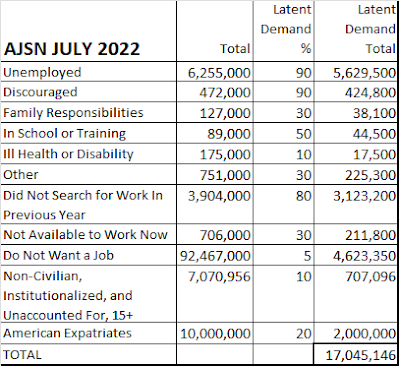
The American Job Shortage Number or AJSN, the Royal Flush Press metric published for 10 years showing how many more positions could be easily filled if all knew they were as easy to get as running an ordinary errand, was almost unchanged – up 23,000, as follows:


No category’s contribution to latent demand changed more than 78,000.  Compared with July 2021 the AJSN has dropped three million, with almost 90% of that from lower official joblessness.  The share of the AJSN from those unemployed edged down 0.4% to reach 33.0%, again less than one third. 

Per the New York Times, the 7-day average of new Covid-19 cases increased 26% from June 16th to July 16th to 130,170.  Other daily pandemic numbers had similar changes, with the same average of deaths up 32% to 424, hospitalizations up 35% to 40,611, and number of vaccinations administered down 25% to 233,440.  The worsening coronavirus is an increasing cause for concern, but is still well short of indicating that people are being imprudent by working. 

So what really happened?  People, though fewer than in the previous month, rejoined the workforce and, this time, consistently got jobs.  Over 15% of those reporting they were officially unemployed long-term in June had lost that status by July.  Adjusted joblessness got even lower.  Pay almost caught up with inflation.  More people, over 80,000, left the institutionalized, armed services, and off-the-grid category above, which has shed an amazing and telling 2.3 million, or almost one quarter, in the past year alone.  Workers are coming back, and they are finding success, hours, and more money.  Accordingly, the turtle strained legs as he took a lengthy step forward.

Friday, July 29, 2022

Working from Home – or Not? Another Month Rolls By

Maybe because the issue is so unsettled, and ultimately involves tens of billions of dollars a year, we’re seeing more and more about whether cubicle sorts of workers need to be in the office.  These are from only July.

As a contractor at a company which had recently downsized or moved many employees, I worked in a large empty room, and felt like I was seeing “Lonely Last Days in the Suburban Office Park” (Emily Badger, The New York Times, July 5th).  These places, with “serene grounds” in “leafy” areas and named something ending in “park,” based on “the very American idea that office workers would do their best work if they could look out at manicured nature instead of the frenetic cityscape,” probably peaked in the 1990s, though were around at least four decades before.  However, “a younger generation wants more urban offices, real estate developers say, or at least suburban offices that feel (italics theirs) more urban, with sidewalks and somewhere different to eat lunch every day.”  Times change, and after over sixty years it shouldn’t be surprising.

Yet every shift will not succeed, as argued in “Hybrid Work is Doomed,” by Ian Bogost in The Atlantic on July 6th.  After tipping his hat to stock advantages of working from home, the author wrote that while “remote, flexible employment might be a win for everyone,” “actually, it isn’t.”  That, Bogost maintained, is because offices “serve as affirmations of a superseding value” which “gives identity to office workers and firms alike, by imposing its practices across the workforce.”  These settings “have never been about increased efficiency,” and indeed, “the intrigue and plotting of office politics, the sense of importance or position afforded by a corner room, the holding of court in a meeting… are not opposed to office life but central to it.”  Office time enculturates workers, which is necessary for management, and perhaps we can never get past that.

We can see the pendulum between remote and office work move some more in Rebecca Knight’s July 7th Business Insider “Less me-space, more we-space:  How a future-of-work architect advises companies to redesign their work environments to get employees back to the office.”  As I have mentioned, business knowledge is forever being lost – the example here is that we have already found that depriving workers of personal space is ultimately detrimental.  The author suggests that “concentrated work” can be done at home, but that not only calls for people to be allowed to stay there but have the ability to choose what work is done on which days.  The interviewed “future-of-work design expert” was planning spaces that looked like living rooms – fine for part of the time, but all day?  That idea will grind to a halt later this decade, as managers discover the wonderful advantage of saving square feet.  And, sometime later, the idea will return…

One side effect of more remote work is that “The Business Lunch May Be Going Out of Business” (Brett Anderson, July 11th, The New York Times).  Called a “power lunch” in the 1980s, the custom of workers, especially those relatively high-ranking, taking long mid-day breaks at usually fancy restaurants goes back longer than that – do you remember the “three-martini lunch”? – and if the title of this article is an overstatement, such indulgences, generally accepted as perks, are rarer, not only due to fewer worker-office days but unsettled in-person reporting mandates.  One high-end place owner asked “With this hybrid workday, is Wednesday the new Monday, or is Thursday the new Friday?  If I can crack that code, I might have a chance.”  Well, so would employees.


What people think they want may not be the same as what they should have, as Chloe Berger expressed in “Millennials and Gen Z are better off returning to office, says future of work expert” in the July 12th Fortune.  She relayed from a former large company chief human resources officer that younger workers have had “feelings of frustration over being less connected to their colleagues in a remote situation,” and “since remote onboarding takes time to catch workers up to speed and feel personal,” they need to be “intentional about how they foster their relationships and the time they come into the office.”  Others have mentioned difficulty in starting new hires in careers, as opposed to contractors on limited assignments, when it is harder to meet others in person.  That’s a problem, and it certainly contributes to the high rates of job-hopping which Berger cited.

Not every flag raised gets saluted, and as published by Berger in Fortune on July 18th, we learned that “Workers are calling their bosses’ bluffs on in-office mandates.”  When employers tell them that they must report in person, many “turn a blind eye,” with, in a recent survey, 35% thinking that “their employer would likely do nothing if they or their peers didn’t go into the office as much as required.”  Another study found that “only half of workers who were expected to return to the office are actually going in five days a week,” and Goldman Sachs’s and Apple’s CEOs got far from universal compliance when they announced office time requirements.  That’s one response, and with a perceived shortage of job candidates, it may be more common.  Yet it would take only one large firm consistently sending people down the disciplinary sequence, and firing some, for that to stop.  Will we get that?  As with everything else about remote work, we don’t know.

Friday, July 22, 2022

More Economy Reality: Earnings by Sex, Bogus Stagflation, Rockets and Feathers, Retirement Delays, and Inflation versus Unemployment

Aside from interest rates, inflation rates, and the chance of a rather peculiar recession, what’s been happening with the American economy?

I’ve written several times over the years about pay differences between men and women, and the case for widespread, long-illegal discrimination is so thin that now in general there are “Young women making more money than young men in nearly 2 dozen US cities:  Study” (Talia Kaplan, Fox Business, April 10th).  Per a Pew Research Center survey, “in 22 of 250 U.S. metropolitan areas, including New York, Washington, D.C. and Los Angeles, women under the age of 30 earn the same amount or more than men.”  A professor who wrote her dissertation on “gender differences and perceptions of pay” called that unsurprising, and credited better information available to job seekers, but did not mention one of the largest factors, the declining birth rate, especially among younger people, which causes much of something else she mentioned, “how long they are going to be working in a particular job.”  As for the chance of reverse discrimination, though, fair is fair, and with men’s and women's hormones not being identical, maturity and suitability for high-quality positions at low ages may not be either.

If predictions of anything like a normal recession were misguided and imperceptive, forecasts of “stagflation” were ridiculous.  Paul Krugman worked to put that non-possibility to rest in “That Was the Stagflation That Was,” in the July 7th New York Times.  He asked, “what are the odds that falling gas prices will get even a small fraction of the media coverage devoted to rising prices?,” which has been debatable in the 15 days since, and “markets are now more or less sounding the all-clear on persistent inflation,” which is almost certain to decline from June’s 9.1% reading with the next report.  It’s a simple matter of being willing to react to changing circumstances. 

Another Krugman piece had the effect of confirming something often believed but factually questionable.  In “Wonking Out:  Rockets, Feathers and Prices at the Pump” (The New York Times, July 8th), he pointed out that President Joe Biden’s exhortation to gas stations to lower prices had more truth than those either on the left or the right first thought.  The reason was that the idea of gasoline prices rising immediately when oil goes up but drifting down only slowly when it falls was substantiated by St. Louis Federal Reserve economists, who confirmed that it actually happens.  Understanding its cause, though, is not yet complete, but one “relatively old paper” attributed it to “when oil prices shoot up, owners of gas stations feel empowered not just to pass on the cost but also to raise their markups, because consumers can’t easily tell whether they’re being gouged when prices are going up everywhere… and gas stations may hang on to these extra markups for a while even when oil prices fall.”  This pattern “seems to be strongest in areas where individual gas stations face relatively little competition.”  I add that relatively steady oil prices, which have not been the case, are the best for price wars, small but steady decreases, and using fuel as a loss leader to push up convenience-store sales.  So this complaint is for real, but has no reasonable solution, other than stations choosing to react to this newly legitimized knowledge by bringing prices down.

The decision of when to leave one’s main job permanently has shifted around for many workers, the most recent trend documented in “Economic worries further older Americans’ pandemic-era plans to delay retirement, survey finds” (Andrew Osterland, CNBC, July 9th).  It’s a dramatic short-term change, as in July 2021, “about one-third of older Americans surveyed by Edward Jones and Age Wave said they planned to delay retirement,” but the number by “early 2022” was 59%.  Complicating the matter, as quoted eminent futurist Ken Dychtwald put it, “retirement is going through a period of transformation,” and not all agree on what that means, choosing between thinking “it began at a specific age,” with some “when they left their main job or began collecting their pension,” and “still others… when they achieved financial independence.”  Dychtwald also said that “people are terrified about running out of money in retirement, and this year has taken a lot of money out of nest eggs.”  Some also got “a taste of what retirement might be like,” by working remotely during Covid gusts.  Expect plenty of change with all aspects of this major life change in the rest of this decade alone.

For a few months there, it seemed to me like more people were upset about higher prices than were elated about almost nobody needing to go without work.  Which is more meaningful?  Peter Coy, in the July 20th New York Times, opined that “Inflation is bad, but unemployment is far worse.”  It’s critical that the Federal Reserve governors take a view on this comparison, as their interest rate hikes or the lack of same will influence both in different directions.  The author maintained that “higher unemployment is worse than higher inflation if you go by the feelings of real people rather than the theories or economists,” as shown by one paper finding that “people are nine to 13 times as likely to report sadness or physical pain in the short term when there’s been a one-percentage-point increase in the unemployment rate as when there’s been a one-percentage-point increase in the inflation rate,” and another placing unemployment rises as “about six times as potent as an increase in inflation in lowering people’s self-assessments” about their lives, something which a previous study found to be five times.  Something for the Fed to think about – and us if we are trying to be objective.  The same goes for the rest of this post.

Friday, July 15, 2022

Unions in 2022 at Amazon and Beyond: Where Have They Been Going, and Where From Here?

Since the time when labor unions were needed for the likes of getting workers’ widows paid for the days when they died on the job, they have taken a long fall in value, constructiveness, and membership, which has fallen from a high of 34% of private-sector workers in the 1940s to 6.3% two years ago.  While participation among government positions has grown significantly, it is not the same, as those workers do not have to deal with people whose own success is tied to cutting costs.  But could unions be coming back?

The main reason they have declined is workplace conditions, which, with physical safety, compensation, hiring practices, unemployment benefits, overall pay, and more, have improved vastly from the middle of the past century.  However, the possibility of worsening has never gone away.

The highest-profile company which has recently spurred its employees to organize into a union is Amazon, where, last year in Bessemer, Alabama, workers voted to start and join the independent Amazon Labor Union.  In the April 6th New York Times, Spencer Bokat-Lindell asked “Does the Amazon Union Win Portend a Comeback for Organized Labor?”  He attributed the effort’s success to problems with warehouse safety and organizers’ “deeply personal, grass-roots strategy,” coupled with TikTok promotional videos.  There have also been “recent union victories at six Starbucks coffee shops in Buffalo,” which may be joined by flight attendants, who also have long-time complaints about scheduling and compensation.  A cause of more, per Bokat-Lindell, could be “broader dissatisfaction with the economy,” including raises not matching inflation.

Those operating unions, who have not been in a mode of frequent successful organizing for decades, are learning from these experiences, as “Amazon Workers Who Won a Union Their Way Open Labor Leaders’ Eyes” (Noam Scheiber, The New York Times, April 7th).  As Scheiber said, the aforementioned previously unusual organizing techniques may spread to many more places.  Disagreements, conflict, and power struggles will certainly appear, but other victories, including “at the outdoor retailer REI,” will fuel interest in doing what seems to work.

One more factor feeding certain workers’ discontent was in the headline of “NY bill targets Amazon quotas,” by the Associated Press and published in the June 8th Times Herald-Record.  That company has been using “warehouse productivity quotas” which “log how workers pack and stow packages,” meaning that “if workers are inactive for a set period of time, the company’s “time off task” tool can ding them for taking too many breaks, which critics have blamed for the company’s injury rates.”  The law would require Amazon, in New York state, to share information on these measures and their use, and “would also prohibit employers from putting in place quotas that prevent workers from taking bathroom breaks or rest periods.” 

Another look at these events, from Daniella Genovese in Fox Business on April 27th, was “Why union efforts are sweeping the nation.”  It named organizing attempts “targeting” Apple also, and told us that “during the first six months of the 2022 fiscal year… unfair labor practice charges… increased by about 14%.”  A Stanford source considered as causes employees being “frustrated with how wealth is allocated under our current system,” and “longing for a sense of belonging and connection to others.”

On June 15th in The New York Times, Lauren Hirsch told us that “Weaknesses in the Social Safety Net Disrupt the U.S. Work Force.”  Participants in a Washington policy forum considered unions a worthwhile force against “monopoly power” held only by employers, a better choice than “more government standards” possibly leading to “government overreach.”  One more win took place in a surprising location and industry, as “Chipotle workers in Maine move to unionize, a first for the chain” (Ken Martin, Fox Business, June 24th).  That was spurred by “unsafe conditions,” and helped by locations being company-owned, a communications and opposition-identifying advantage not available at, for example, McDonald’s.

For almost 100 years, unions have offered their organizations to employees.  American business executives, especially those managing buildings full of relatively low-paid workers, are now on notice that changes originating with the Covid-19 pandemic, expected rates of pay on the upswing, inflation the highest in 40 years, and high employee awareness of workplace problems and inequities will bring them back if management won’t cooperate.  Financial strength, number of apparently happy workers, and overall size (Walmart was also named in at least one of these articles) will not protect them.  In short, it’s the 1940s again, and that’s healthy.  It is not the unions, or even the workers, who will decide how much organizing will take place later this decade – it is the employers.