Friday, December 8, 2023

Jobs Report Roars Back – AJSN Shows Latent Demand Down Almost Half a Million

Last month’s Bureau of Labor Statistics Employment Situation Summary was the worst all year.  But any thoughts that it would start a trend were dashed this morning.

In November, our economy added 199,000 net new nonfarm payroll positions.  That was not only at the high end of published predictions – the ones I saw were 150,000, 190,000, and 200,000 – but four times what we needed to cover population increase.  All but one of the statistics I report on improved.  Seasonally adjusted and unadjusted unemployment reached 3.7% and 3.5%, down 0.2% and 0.1%.  The number of people with jobs gained 473,000 to 162,149,000, and officially unemployed, seasonally adjusted, dropped 200,000 to 6.3 million.  The long-term jobless out for 27 weeks or longer fell 100,000 to 1.2 million, and those working part-time for economic reasons, or holding on to shorter-hours propositions while seeking full-time ones, lost 300,000, getting to 4.0 million.  The measures of how common it is for Americans to be working or counted as technically jobless, the labor force participation rate and the employment-population ratio, rose 0.1% and a large 0.3% to arrive at 62.8% and 60.8%.  Average hourly private nonfarm payroll wages added 10 cents, more than inflation again, to $34.10.  Those claiming no interest in work were 9,000 more numerous and numbered 94,839,000.

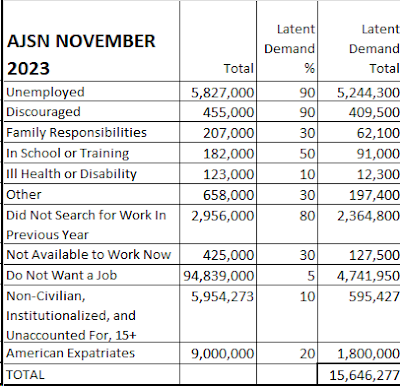
The American Job Shortage Number or AJSN, the metric showing how many additional positions could be quickly filled if everyone knew they would be easy to get, lost 488,000 from last month, and ended up at this:


Ninety percent of this month’s change was due to fewer unemployed and fewer American expatriates, the current State Department estimate of whom fell one million.  The share of the AJSN from those officially jobless was 33.5%, down 0.5%.

Compared with a year before, the AJSN decreased 154,000, with the change in expatriates, and in those wanting work but not looking for it for at least a year, more than offsetting an increase in the jobless count. 

If we draw a two-month line from September to November, we get average monthly jobs gains of 174,500, adjusted and unadjusted unemployment each down 0.1%, 100,000 fewer officially jobless, long-term unemployment unchanged, the employment-population ratio the same but the labor force participation rate up 0.4%, those working part-time for economic reasons down 100,000, people employed up 480,000, and the hourly wages above up 22 cents.  The AJSN fell 543,000.  The only minus is the count of those denying any interest in work, which over the past two months increased 428,000. 

All that means we’re still doing superbly.  We, in general, more than cancelled out the previous month’s disappointing showing.  No recession, no shortage of work, wages strong, and inflation at 3%.  Overall, these are great times for the American economy.  The turtle took a double-sized step forward.

Friday, December 1, 2023

Four-Day Workweeks – Do They Make Sense?

Since the five-day, 40-hour week was solidified in the 1930s, people have talked about full-timers reporting for less.  It seemed like the logical next step, but 90 years on we have seen no such thing. 

There are several reasons for that.  The schedule has worked well.  People can coordinate family and leisure activities effectively, given that they are spending, plus commuting, only about one-quarter of their regular working weeks there.  Overtime can be easily added to either weekdays or weekends.  Studies have shown that productivity starts to fade after about that number of hours.  Remote work, though, has destroyed the barrier between home and office, so is it possible we are ready to cut back from the venerable Monday through Friday?

In “Push for a 4-day work week picks up steam – and critics” (Fox News, February 5th), Aaron Kliegman summarized the contemporary situation.  “A growing number of lawmakers, business leaders, and academics are pushing for the U.S. to embrace a four-day work week, leading critics to question the wisdom of what would be a cultural sea change for the country.”  While some pointed out that “not every business is able to cut its work time while maintaining the same level of salaries,” others called it “something that offers a real win-win possibility for both employers and employees,” and “academics have been increasingly floating the idea,” along with “a recent CNN opinion piece” which said its advocates were ”striking a blow at the absurd American culture of overwork.”  Or, perhaps, as a Wharton processor put it, she did not think that “our employers are going to believe that you can get as much work done in four days as in five.”

The last view did not seem the most common, as “Is the US ready for a four-day work week?” (Austin Westfall, Fox Business, also February 5) told us that “Research from Robert Half, an employment agency, shows a large majority of US managers (93%) support a four-day workweek for their team,” and “the data shows 64% expect their company to transition to one within the next five years.”  No surprise, though, is the headline of “Employers tried a 4-day workweek program.  Employees said they were healthier and happier” (Marina Pitofsky, USA Today, February 21st).

So where is the middle ground?  Perhaps it’s described in “The pros and cons of a 4-day workweek” (Paula Peralta, Benefit News, September 7th).  In the former category, Peralta named “requested by employees” (41% in a “recent” study conducted by the International Foundation of Employee Benefit Plans), “retention strategy” (36%), “work-life balance and rethinking company culture” (36%), and “recruitment strategy” (27%).  The points against four-day workweeks were “lack of interest by upper management” (42%), “difficulty implementing it organization-wide” (38%), “negative impact on business operations” (36%), “unsure if it would work with organization structure” (36%), and “unable to support the customer base” (32%).  “Alternatives” named in the survey were “working remotely on certain days of the week (hybrid)” (75%), “flexible work hours (61%), “working remotely full-time” (50%), “part-time schedule" (35%), and “compressed workweeks” (24%). 

If we are going to have four-day timetables, we would need to address a few more things.  First, if only some companies have them, it could put great pressure on ones in the same industries to do that as well, unless they paid their five-day employees up to 25% more.  Second, it could call for changes in how much idle time cubicle workers would have – perhaps they would not be enthusiastic about shorter schedules if they were expected to produce more per hour.  Third, there in most cases could be no Friday equivalent, no day where expectations, performance, and office hours are often lower – would that be acceptable to everyone?  Fourth – and this is the problem nobody seems to want to address – if people are now working more than 40 hours per ordinary week, what would a 32-hour schedule really mean?  Answer and get reasonable agreement on these and I can stand behind four-day workweeks – if not, they just plain won’t succeed. 

Wednesday, November 22, 2023

Driverless Cars, Even in Limited Roles, are Conking Out

Even with vastly reduced expectations, autonomous vehicles are falling short.

In the August 9th New York Times, Yiwen Lu told us “San Francisco Balks at Expanding Driverless Car Services on City’s Roads.”  She called them “a jarring sight” “that “has become common” there.  Cruise, which was offering taxi rides, and Waymo, whose autonomous cars I saw tested in Arizona four years ago, wanted to charge customers “throughout the city, round the clock.” Although none thus far had been “blamed for any serious injuries or crashes,” there had been incidents in which the vehicles, on roads, “simply shut down and won’t move.”

In a piece from Atlantic ten days later, Anna Wiener reported that “Robo-Taxis Are Legal Now,” because of a California Public Utilities Commission vote to approve the autonomous vehicle increase above.  It didn’t take long for the people against it to seem vindicated, as a week later “a driverless Cruise car, carrying a passenger, collided with a fire truck,” apparently  not yielding to it when traffic controls alone indicated it would not need to, and “a couple of hours later… another driverless Cruise car was involved in an accident, after it responded to an oncoming car by braking and stopping short.”  The next day, the state’s Division of Motor Vehicles asked that Cruise cut its maximum-allowed number of autonomous vehicles running there in half, and, per “Cruise Agrees to Reduce Driverless Car Fleet in San Francisco After Crash,” on August 18th and also in the New York Times by Yiwen Lu, that request was granted. 

In October came another mishap there.  As Julie Angwin wrote in “Autonomous Vehicles Are Driving Blind” (The New York Times, October 11th), earlier that month “a woman suffered traumatic injuries from being struck by a driver and thrown into the path of“ a driverless car.  As well, “San Francisco’s fire chief… recently testified that as of August, autonomous vehicles interfered with firefighting duties 55 times this year.”  Angwin blamed a lack of “federal software safety testing standards for autonomous vehicles,” and expanded her concern to artificial intelligence in general.

Another permutation was the subject of “Remote Driving Is a Sneaky Shortcut to the Robotaxi” (Sean Lightbown, Wired.com, October 18th).  “On the busy streets of suburban Berlin, just south of Templehofer Feld, a white Kia is skillfully navigating double-parked cars, roadworks, cyclists, and pedestrians.  Dan, the driver, strikes up a conversation with his passengers, remarking on the changing traffic lights and the sound of an ambulance screaming past in the other direction.  But Dan isn’t in the car.”  Dan is a “teledriver,” working for “German startup Vay.”  That capability had been used to back up driverless vehicles during testing and could now be used to cover “driver shortages at airports, harbors, or in the trucking industry” with “a bank of remote drivers available around the world.”  It could allow, for example, intercity truck driving by people not needing to be away from their families, with longer hours per vehicle as one remote driver could take over for another.

The self-driving situation discussed before worsened soon thereafter, as “Cruise’s Driverless Taxi Service in San Francisco Is Suspended” (Yiwen Lu and Cade Metz, The New York Times, October 24th).  It was made by the state DMV, due mainly to the accident earlier that month, in which the pedestrian was “trapped under the driverless car,” which then “tried to pull over” and “dragged the pedestrian until it stopped.” 

Four weeks later, another piece by Lu in the Times summarized events in “’Lost Time for No Reason’:  How Driverless Taxis Are Stressing Cities.”  One involved two autonomous vehicles, each blocking a side of the road which “added seven minutes” to an ambulance run.  San Francisco had seen “more than 600 self-driving vehicle incidents… from June 2022 to June 2023,” and Austin, another though smaller hub for driverless taxicabs, had 52 “incidents” between July 8 and October 24.  Cruise has now “suspended its autonomous vehicle operations,” and its CEO resigned on November 19th. 

The future is not entirely hopeless for self-driving taxis.  Lu reported that Nashville and Seattle, still on track to allow them, had started training for firefighters on dealing with them, and Phoenix, after three years of allowing “autonomous taxi services,” has 200 with few complaints.  That is good, since their developers clearly have things to learn about different locations.  The promise of autonomous vehicles is still great – we still have over 30,000 annual human-caused road deaths every year – so we should all hope that 2023 will go down as the worst year for their technology. 

Friday, November 17, 2023

Job-Seeking Now – What’s Happening? What’s Changing?

There are good and bad things about looking for work in 2023.  It may be that unemployment has been below 4% for a year or so, and there are almost a record number of job openings, but it’s still not easy, and getting hired is not routine.

It’s hardly a great time to be trying.  At least it wasn’t six months ago, according to “Why job searches suck right now” (Adrienne Matei, Insider, May 22nd).  “Applicants are sending out hundreds of job applications and hearing nothing back.  Ghost jobs, AI resume screening, and a lopsided economy are making the job search miserable.”  Also, “economic instability, opaque hiring processes, and the destabilizing rise of technologies like generative AI have converged into an environment where it’s hard for job seekers to feel like they have even a basic sense of what’s going on,” and “finding a job right now isn’t only tough, it’s deeply weird.”  As I wrote 12 years ago, job openings do not mean job hiring – apparently, per Matei, that is true now more than ever.  Some fields have also been recently economically damaged, especially “real estate, media, and tech,” and, overall, “discombobulation is par for the course.”

Another recent work-searching problem was the subject of “Want a Job?  Cool, There are 17 Interviews” (Alison Green, Slate, May 23rd).  One respondent said that for a single position he had already had seven, with apparent interviewer coordination and competence issues, as he was repeatedly asked the same questions.  The high mark, though secondhand, was a friend of a respondent claiming she had had 29 (!) half-hour interviews, and was not hired, without the position being filled.  As well, remote interviews have made it possible for them to be scheduled one a day, and sample work assignments, some even to be completed before any interviews, are getting common and lengthier. 

How can people apply artificial intelligence to the job search itself?  In Benefit News on October 17th, Deanna Cuadra gave us some insight in “How to use AI to write a great cover letter.”  The way is to “pick the right AI tool,” and some even specialize in cover letters; “know how to prompt AI” by asking it the needs, priorities, and responsibilities the advertised position is likely to involve; “don’t let AI fears hold you back”; and consider adding your own changes to the tool’s output.  On November 6th in Wired.com, Caitlin Harrington, in “This AI Bot Fills Out Job Applications for You While You Sleep,” told us about “software engineer Julian Joseph,” who used LazyApply’s Job GPT capability, which, after he provided “some basic information about his skills, experience, and desired position,” applied to 5,000 jobs on his behalf.  He got “around 20” interviews, and one job offer. 

After knowing of employers cutting off unsuccessful candidates without any politeness, I can’t say I was sympathetic to read, also from Cuadra in Benefit News, November 13th’s “Job candidates are still ghosting employers – and the interview process is to blame.”  Not the marathons described above, but “a poor interview experience,” and, even now, “over one-third of candidates have experienced discriminatory interview questions, most commonly around their age, race and gender.”  Also, per a Greenhouse study, “19% of job seekers have changed their names on their resumes, with 45% doing so to sound more white, 42% to sound younger and 22% to sound like the opposite gender,” with age discrimination the largest perceived problem.  As for the ghosting, what’s sauce for the goose is sauce for the gander.

To end with something positive, we read in Fox News on October 16th that “US companies increasingly eliminate college degrees as a requirement amid “out-of-control” school costs.”  Those cited as announcing “plans to reduce the number of jobs that require college degrees” were Walmart, IBM, Accenture, Bank of America, and Google – not minor firms.  The real reason likely is a lack of candidates, as needing higher education, a dramatic shift from pre-1970 policy, was more of a way to thin the field than anything needed for work.  This is a positive trend, and I hope that other artificial barriers, such as certifications for the like of hairdressers, will also go away.  It is time.  And it is also time for employers to treat those seeking to work for them with the kind of respect they expect themselves.

Friday, November 10, 2023

Electric Vehicles – Still Controversial, and No, Not Poised to Take Over

The past couple of years have been huge for electric cars, trucks, buses, and other transportation devices.  Per David Wallace-Wells in “Electric Vehicles Keep Defying Almost Everyone’s Predictions,” on January 11th in the New York Times, there were “almost 30 million” in existence, tripling in two years as has their market share.  In Germany and Norway, they made up 55% and 80% of new vehicles, and China almost sextupled their percentage in two years, to 20.3%.  Also, “there are 10 times as many electric scooters, mopeds and motorcycles on the road as true electric cars.”  In all, per Wallace-Wells, “as with everything else on climate, it’s not one story unfolding but many, and all at once.”  Back to that later.

Other things that have happened in this area are hardly as overwhelmingly positive.  As Greg Norman wrote in Fox Business on January 3rd, “Tesla fined $2.2M for exaggerating driving range of its vehicles:  report.”  The problem was in winter, when “the actual driving range” dropped by up to half.  In Atlantic on January 4th, David Zipper opined that “Electric Vehicles Are Bringing Out the Worst in Us.”  His concern was that “automakers’ focus on large, battery-powered SUVs and trucks reinforces a destructive American desire to drive something bigger, faster, and heavier than everyone else.”  That problem has been worsened by their “huge batteries,” resulting in, for example, a Chevrolet Silverado weighing a ton and a half more in its electric version, that and other differences often serving to neutralize environmental benefits.

That same month, we saw “Wyoming lawmakers push for electric-car ban and to limit sales by 2035” (Natalie Neysa Alund, USA Today, January 17th).  They cited an insufficient number of charging stations, problems with “critical minerals” in their batteries, and economic damage to oil-company employees.  Contrarily, California’s government has announced an end to allowing new gasoline-powered “cars, pickups and SUVs,” to take effect in 2035.

On the issue of metals, on September 16th, The Economist issued an article, “Keep digging,” which cited the Energy Transitions Commission think-tank as projecting that, in pursuit of a “carbon-neutral world,” requiring among other things “a 60-fold increase in the fleet of electric vehicles,” demand for copper, nickel, cobalt neodymium, graphite, and lithium will increase from 50% to 600%, outstripping current mining capability.  As excavating mines, per this piece, takes from 4 to 17 years, that is more timely a problem than it may seem.

How is the market for electric vehicles looking now?  This month, two contributions seemed almost to disagree.  Bloomberg’s Big Take on November 8th described “The global fight over EVs,” with that organization predicting that “all forms of EV sales will hit $8.8 trillion by 2030 and $57 trillion by 2050.”  The other article was “Automakers Delay Electric Vehicle Spending as Demand Slows,” on November 7th in the New York Times; “in recent weeks, General Motors, Ford Motor, and Tesla cited slower sales,” though the share of electric vehicles in US new-car purchases rose year-over-year in July through September from 6% to 8%. 

We’re still seeing growth, but it may have limits.  Electric cars certainly have their American niches, but there are real reasons why they may not conquer the automotive marketplace without coercive policies or outright bans.  First, with weight problems and American electricity coming 35% from fossil fuels, they are not nearly as environmentally beneficial as they may seem.  Second, battery life has only fundamentally improved when they are gigantic, and we are nowhere near having one with a 500-mile range, fitting in an ordinary car trunk, mass-produced, and acceptably inexpensive.  Third, with auto insurance companies charging extra for multiple vehicles, having an electric car for short trips and a gas-powered one for longer ones seems impractical.  Fourth, though there have been real improvements in the number of charging stations and their reliability, in many places the infrastructure is not good enough, and seems, nationwide, to be at least a decade away.  Fifth, prices are still too high.

The best applications for electric vehicles are those that run for consistently limited mileage and can recharge daily during off-hours, such as city buses, taxicabs, school buses, and local delivery trucks.  Another worthy development is hybrids, which combine the reliability of liquid-powered vehicles with low emissions and high fuel economy.  It may turn out that demand for privately-owned electric cars will level off, especially in some areas.  If that happens, we should not be shocked – it will be the market, and other aspects of reality, speaking. 

Friday, November 3, 2023

Finally, a Lousy Jobs Report, With AJSN Showing Latent Demand Almost Unchanged

For months on end, when I pulled the Bureau of Labor Statistics Employment Situation Summary, I have seen strongly positive results, exceeding industry expectations and displaying the United States doing even better on the jobs front.  Not this morning.

The number of net new nonfarm payroll positions was 150,000, favorable for a country needing less than that to maintain the same position.  Although that was below the published 180,000 and 190,000 estimates, it was the best number I saw today.  Adjusted unemployment rose 0.1% to 3.9%, with the unadjusted version staying at 3.6%.  The number of employed gained only 7,000 to 161,676,000, while the count of those claiming no interest rose 419,000 to 94,830,000.  At 6.5 million, there were 100,000 more unemployed, the same gain for those out for 27 weeks or longer, to 1.3 million.  The two measures of how common it is for Americans to be either working or one sought offer away, the employment-population ratio and the labor force participation rate, worsened 0.2% and 0.1% to reach 60.2% and 62.7%.  Average nonfarm payroll hourly wages gained 12 cents, more than inflation, to reach an even $34.00.

The American Job Shortage Number or AJSN, the statistic showing how many additional positions could be quickly filled if all knew they would be easy and routine to get, lost 55,000 as follows:


AJSN OCTOBER 2023

Total

Latent Demand %

Latent Demand Total

Unemployed

6,098,000

90

5,488,200

Discouraged

428,000

90

385,200

Family Responsibilities

102,000

30

30,600

In School or Training

148,000

50

74,000

Ill Health or Disability

80,000

10

8,000

Other

634,000

30

190,200

Did Not Search for Work In  Previous Year

3,045,000

80

2,436,000

Not Available to Work Now

602,000

30

180,600

Do Not Want a Job

94,830,000

5

4,741,500

Non-Civilian, Institutionalized, and Unaccounted For, 15+

5,997,366

10

599,737

American Expatriates

10,000,000

20

2,000,000

TOTAL


16,134,037


Increases in those unemployed and discouraged were more than offset by a drop in those wanting work but not looking for it in the previous year.  The share of the AJSN from officially unemployed people was 34.0%, up 0.4% from September. 

Compared with a year before, the AJSN gained 175,000, with a 440,000 rise from people unemployed mostly offset by the drop in those not searching for it and elsewhere.

So, when we did well on net new jobs, why must I give this morning’s report a thumbs down?  Because not only were all the other figures I track worse, but unemployment rates were helped by the increase in those leaving the labor force and claiming no interest.  Perhaps we are reaching a plateau.  As before, that wouldn’t be bad, but it wouldn’t be progress either.  The turtle took a breather and stayed right where he was.

Friday, October 27, 2023

Artificial Intelligence is an Awfully Wobbly Juggernaut

For something that was supposed to be taking over the world, AI is tottering.  I can’t speak for the status of the technology itself, but that’s not the issue.  How it progresses and what it ends up doing will be decided in other realms:  legal, financial, social, regulatory, and more.  What’s been happening with AI prospects over the past two and a half months?

The first clue was in Futurism, updated on August 11th, “AI Is Starting to Look Like the Dot Com Bubble.”  This piece, modified by Maggie Harrison, started “as the AI industry’s market value continues to balloon, experts are warning that its meteoric rise is eerily similar to that of a different – and significant – moment in economic history:  the dot com bubble of the late 1990s.”  It is not that no companies are profitable – the hugest ones of Microsoft, Meta, and Amazon are – but there are many others, getting venture capital, which “have yet to even introduce a discernable product.”  It is time to realize that while there may well be Fords and Chevrolets, there will be Stutzes and Hupmobiles as well.

Per Ian Prasad Philbrick in the August 27th New York Times, “Regulating A.I. Requires Congress to Act Nimbly.”  The author pointed out that “major federal regulation” has taken as long as 90 years to materialize after “invention or patenting,” with nuclear energy, with the shortest interval, still taking four years, and airplanes and automobiles 20 and 70 respectively.  Although our senators and representatives have attended informational sessions, it is a challenge, and will take “perhaps a decade or more.”

A strong indicator of how people’s attitudes can trump technical achievements was in the September 10th New York Times, Kashmir Hill’s “Anonymity Is Over.  Big Tech Tried to Save It.”  It related how, six years ago, Facebook technologists worked out a way to identify faces and attach names and other information to them.  A related thing had been developed by Google in 2011.  Neither was released, as Google “decided to stop” what it was doing, and Facebook considered it “too dangerous to make widely available.”  Some are now using related facilities, but far fewer than their utility and technical merits would justify.

On the recent idea that artificial intelligence will at least help productivity, Aaron Mok, in Business Insider on October 2nd, relayed that “OpenAI’s ChatGPT can actually make workers perform worse, a new study found.”  The research, from Boston Consulting Group, found that when people used ChatGPT with GPT-4 for work requiring capabilities the software was known to have, such as “brainstorming innovative… concepts, or coming up with a thorough business plan,” the tool excelled, but on “more open-ended tasks” such as offering business recommendations, it would make large errors, dangerous “because the  consultants with AI were found to indiscriminately listen to its output – even if the answers were wrong.”  It will be a challenge for businesses to distinguish between these two rough categories.

There were things to think about in “Knowledge vs. intelligence amid the hype and hysteria over AI” (Mihai Naden, Fox News, October 2nd).  Naden considered intelligence to require not only evidence of ability to perform, but also what of two resources they required.  As “to win a game of chess at the expense of energy that a small town consumes in a week is unsustainable,” “artificial entities could justifiably claim intelligence if, in executing a task, they would use as much energy or less, and as much data or less, than a living entity performing the same task.”  That may be the criterion we need.

On the positive side, we have Paul Krugman’s October 3rd New York Times “A.I. could be a big deal for the economy (and for the deficit too).”  Although he saw generative AI as “souped-up autocorrect,” he thought it could massively improve productivity in that role.  He included a Goldman Sachs chart with 23 different industries, each divided into “no automation,” “AI complement,” and “likely replacement” of workers.  The field faring best was “building and grounds cleaning and maintenance,” with about 95% of employees in the first category, and “legal” the worst, ripe for a 40% job loss.  Some areas, such as sales, education, social services, and computers, were 100% complemented.  Of course, this does not include other sources of automation, globalization, and efficiency.

Per Ed Zitron in Scientific American on October 17th, “AI Is Becoming a Band-Aid over Bad, Broken Tech Industry Design Choices.”  He said iPhones came with 38 apps, 27 of which could be removed, and users would likely add more, but Apple is relying on AI interfaces instead of ones users could handle themselves, leaving “a Matryoshka of bolted-on features.”  Other vendors, according to Zitron, are similarly at fault.  Not an AI problem as such, but something to affect its reputation.

On October 18th in the New York Times, Kevin Roose said that “Maybe We Will Finally Learn More About How A.I. Works.”  Developers have communicated poorly about how the software was formed, including its use of copyrighted material and how it shares data.  GPT-4 got a 40% “transparency score,” not far off the 54% maximum among ten popular models.  Is it true or false that “we can’t have an A.I. revolution in the dark.  We need to see inside the black boxes of A.I., if we’re going to let it transform our lives”?  That is for us to decide.

Most recent is a reminder that, even for the largest companies, “Long on Hype, A.I. Is No Guarantee for Profits” (Andrew Ross Sorkin et al., The New York Times, October 25th).  Although both are deep into the technology, Microsoft has done far better than Alphabet since their earnings reports the day before, with a one-day 3.9% increase instead of a 6.2% decrease.  And Meta’s stock suffered the same day for other reasons.  So, it’s not enough to identify Ford or General Motors by their products – they must make money as well.  About that, we still, ample attention notwithstanding, do not know.  By the same token, we cannot see where artificial intelligence will wind up – regardless of our hopes and fears.